

Trump Heads to China for Summit with Xi as Iran War Looms

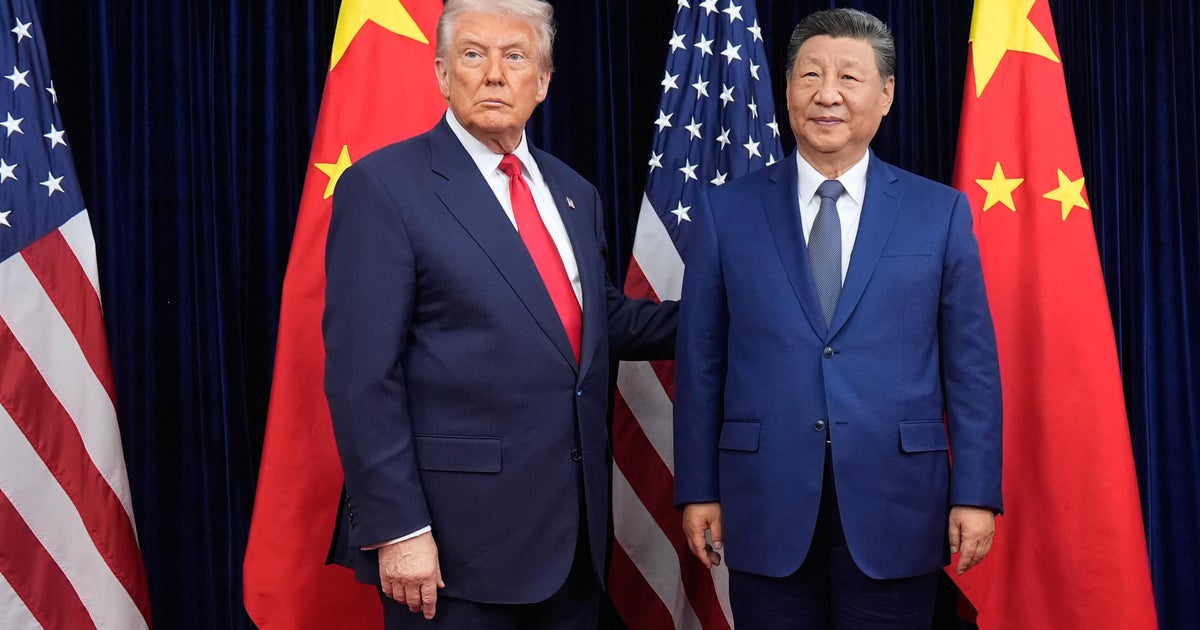
WASHINGTON — President Trump will travel to China on Tuesday for a summit with Chinese President Xi Jinping, a meeting he delayed because of the war with Iran.
Trade tops the agenda for the two leaders, but the fragile situation in Iran and supply chain problems in the Persian Gulf will demand attention. The president said Monday that energy and Taiwan will also come up. Xi wants to bring Taiwan fully under Beijing's control without U.S. interference.
Mr. Trump praised Xi before the trip.
"He's a great gentleman. I find him to be an amazing, amazing man," the president told reporters Monday in the Oval Office.
"I have a very good relationship with President Xi," he added last week in the Oval Office. "You know, I find him to be a tremendous guy. And we get along well, and you see how we do — we do a lot of business with China, making a lot of money. We're making a lot of money."
On Truth Social last week, the president said Xi would give him a "big, fat hug" at the summit.
Mr. Trump plans to depart the White House on Tuesday. Beijing sits 12 hours ahead of Washington.
Business leaders may join his delegation, a White House official said. The list includes Elon Musk, Apple's Tim Cook, BlackRock's Larry Fink and Goldman Sachs' David Solomon, among others. It's unclear who will go.
Both Washington and Beijing aim to steady their relationship, foreign policy experts said. Neither wants to disrupt it.
"Their top concern really is about how to stabilize the U.S.-China relationship so that the two sides can engage in a longer-term strategic competition for an indefinite period of time without accidental spillover to militarize the conflict," said Zongyuan Zoe Liu, a senior fellow for China studies at the Council on Foreign Relations.
For both, "the summit itself, I'd say, is already the deliverable," Liu said.
Henrietta Levin, a senior fellow at the Center for Strategic and International Studies who focuses on China, said Beijing entered the summit confident even before the Iran war. "China already felt very confident going into this summit when the meeting was originally anticipated for March," she said. She added, "They feel they won the 2025 trade war."
"The war in Iran probably increases their confidence to some degree," Levin said. "They see the U.S. distracted from Asia, burning through munitions stockpiles that are very important for building deterrence in Asia. So in some incremental way, Beijing may feel more confident now, but I think that's a change in degree rather than a reorientation of China's perspective."
Mr. Trump said last week in the Oval Office that he and Xi will discuss Iran. Xi has "been very nice about this," he said, given that much of China's oil passes through the Strait of Hormuz. China buys the most oil from that strait, though it holds reserves.
The congressional U.S.-China Economic and Security Review Commission states that Chinese purchases make up about 90% of Iran's exported oil, supporting its economy.
The president told Fox News last week he is "not overly disappointed" with Beijing but said China "could help a lot more" on Iran, especially to normalize the Strait of Hormuz.
"He's been very nice about this," Mr. Trump said of Xi. "In all fairness, he gets like 60% of his oil from Hormuz. And he's been, I think he's been very respectful. We haven't been challenged by China."
China has shown little public interest in aiding the U.S. in Iran. Just before the trip, the Treasury Department imposed new Iran sanctions on several China-based businesses. China vowed to protect those firms.
Trade will feature prominently despite a calm after the 2025 trade war. Both sides want to avoid another turbulent year, Levin said.
The U.S. seeks narrow commercial deals with quick impact that the president can tout in a press release or on Truth Social, she said. China pursues broader, long-term strategic goals.
"China is focused on strategic questions, the answer to which will shape the future of 21st century Asia," Levin said.
Liu said China needs to address trade less than the U.S. does. "They've shown that they know how to fight a trade war," she said of China.
Tariffs on Chinese imports hit 145% last year. After exchanges, the countries reached a one-year deal suspending many penalties into late 2026. The Supreme Court struck down some emergency tariffs in February, but others on Chinese goods remain.
Mr. Trump said Monday he expects Taiwan to arise because "it always comes up."
"He'll bring on Taiwan I think more than I will," he said.
Taiwan did not come up at their last in-person meeting in October on the sidelines of the Asia-Pacific Economic Cooperation summit in South Korea, Mr. Trump noted then, surprising foreign policy circles.
Beijing hopes to sway the president toward its view that Taiwan belongs to China, Levin said. While Secretary of State Marco Rubio and some Republicans back Taiwan support, "Beijing sees an opportunity here because President Trump has expressed a certain ambivalence in his rhetoric," she said.
A reporter asked Monday in the Oval Office if the U.S. will keep selling weapons to Taiwan.
"Well I'm going to have that discussion with President Xi," he replied. "President Xi would like us not to."
China views Taiwan as a domestic matter and resists concessions there, Liu said. "Their core logic is Taiwan is China's domestic affair,"
Levin said Americans should care about Taiwan for economic and democratic reasons.
"Taiwan is the linchpin of the modern global economy," she said. "There is no AI revolution without Taiwan. They play an irreplaceable role in global value chains that underpin so much of what we associate with modern life."
Taiwan produces most of the world's semiconductor technology. Its fate also tests U.S. commitment to allies, she said.
"Taiwan is a thriving democracy that shares American values," Levin said. "That may not resonate with President Trump personally, but I think that more broadly, the question of whether the U.S. is capable and willing to maintain peace and stability across the Taiwan Strait is seen as a test of broader U.S. staying power in the Indo-Pacific and the world."
What's Your Reaction?
 Like
0
Like
0
 Dislike
0
Dislike
0
 Love
0
Love
0
 Funny
0
Funny
0
 Wow
0
Wow
0
 Sad
0
Sad
0
 Angry
0
Angry
0




Comments (0)