

Expedition finds last tropical glaciers in Indonesia shrinking fast

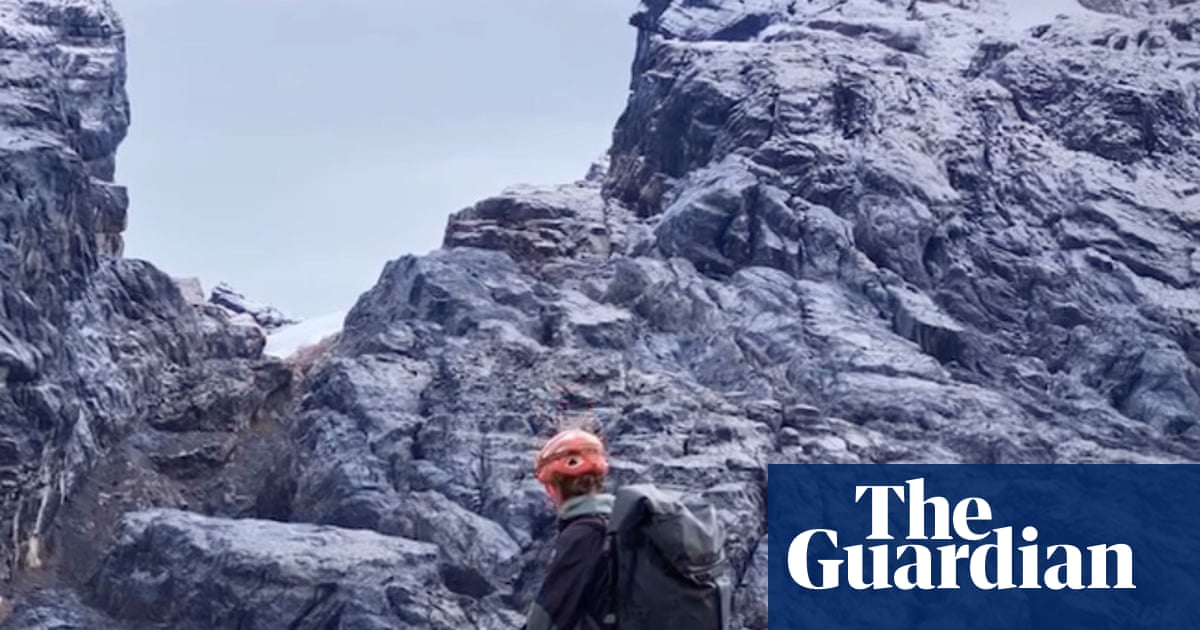
An expedition to document the final days of the last tropical glaciers in Oceania has captured footage of ice vanishing at a rapid pace on Puncak Jaya in West Papua, Indonesia.
The mountain’s two remaining glaciers, known locally as eternal snow, have survived past earlier forecasts that they would disappear by 2026. The larger of the two has lost 95 percent of its area since 2002, according to the survey.
“The ice will be gone: it’s not a question of if, it’s a question of when,” said Klaus Thymann, a Danish explorer and founder of the environmental charity Project Pressure. “And ‘when’ is coming very, very soon.”
Tropical glaciers exist mainly in the Andes but also in East Africa and Indonesia. They are losing mass quickly as rising temperatures from fossil fuel emissions melt the ice.
Thymann said the loss left him emotional after he filmed the glaciers on a rare clear morning. “On a philosophical level, you take eternity – something that’s an abstract, human construct – and we are even now killing our own constructs,” he said.
Puncak Jaya lies in disputed territory on New Guinea, where Indonesia took control after invading the former Dutch colony in 1963. The last major scientific expeditions to the glaciers occurred in 1973 and 2011.
During a two-week trip in November, Thymann’s team used drones and satellite positioning to build a 3D model of the mountain. Constant rain limited the windows for clear photography.
Papua’s tropical glaciers lost 97 percent of their ice mass between 1980 and 2024, according to a study published last month by researchers at Papua University. Four of the six glaciers have already vanished, and the remaining two are expected to disappear by the end of the decade.
“It is deeply saddening,” said Francine Hematang, the study’s lead author. “This is the only tropical glacier in Indonesia and south-east Asia, and it continues to shrink at an alarming rate.”
A separate study published in December found that glacier surface area has fallen more than 99 percent since 1850 and about 65 percent since 2018. It reached the same conclusion about the glaciers’ imminent disappearance.
David Ibel of Friedrich-Alexander-University Erlangen-Nürnberg, who led that study, said drone surveys help overcome limits of satellite imagery caused by cloud cover and rugged terrain.
The glaciers sit in one of Earth’s wettest regions and are heavily affected by the El Niño weather pattern, which was strong in 2023-24 and is forecast to return this year.
Thymann said a second goal of the expedition, carried out with Trimble and Pix4D, was to create a detailed record before the ice is gone. “Believe me, I would much rather there was ice than we had to resort to creating 3D models for future generations,” he said.
What's Your Reaction?
 Like
0
Like
0
 Dislike
0
Dislike
0
 Love
0
Love
0
 Funny
0
Funny
0
 Wow
0
Wow
0
 Sad
0
Sad
0
 Angry
0
Angry
0










Comments (0)