

Australian farmers battle mouse plague amid rising fuel costs

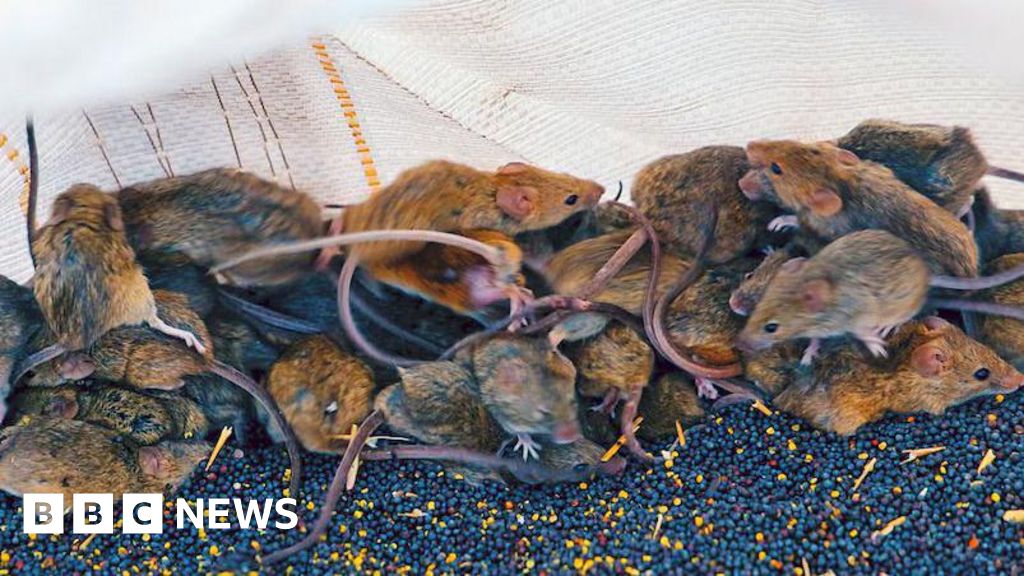
A mouse plague is hitting farmers across large parts of Australia, with rodents running through homes and destroying grain crops.
The outbreak adds pressure on growers already facing higher fuel and fertiliser costs linked to the US-Israeli war on Iran.
Farmers have spent hundreds of thousands of dollars on replanting eaten crops or laying bait made of sterile seeds coated with poison.
"It's a big cost and it's not just the price of the bait," said Geoff Cosgrove, 43, who runs a 14,000-hectare farm in Mingenew, Western Australia, where he grows wheat, canola, lupin and barley.
"They do play with your mind — running around at night, in the ceiling, the air conditioning units. You can hear them and you can smell them — it's like a decaying body."
Cosgrove has farmed for 25 years and has baited only twice before. He said this year's plague is far worse than the one in 2021.
That year, mice swept through New South Wales and parts of Queensland, forcing hundreds of prisoners to move after damage at a jail.
This time, farmers in Western Australia first reported plague numbers in March, followed soon after by South Australia.
About two hours north of Cosgrove's farm, agronomist and farmer Belinda Eastough, 59, said mice are staying in the paddocks because of leftover grain from last year's record harvest.
"Last year, we had a record-breaking harvest so that gives the mice a lot of food," she said from her 5,500-hectare farm in Nolba, 80 km northeast of Geraldton.
Summer rain then produced green shoots, giving the mice extra food. Eastough estimates 8,000 to 10,000 mice per hectare in her canola fields.
"Sometimes we've had mouse plagues, and the numbers will crash once they run out of food but this year, they haven't," she said.
The autumn planting season is now under threat. Eastough advises farmers to lay bait right after seeding, because mice eat the seed from the furrows overnight.
"If you finish seeding at 8 pm at night and you come in the next day, you'll have rows of crop missing," she said.
Eastough said diesel and fertiliser prices have doubled since the Iran war began in February. "The mouse thing is another thing thrown on top, another headache."
Steve Henry, a research officer at Australia's CSIRO science agency, said a plague is normally defined as 800 mice per hectare. In Western Australia and South Australia, counts are in the thousands.
On a recent visit, Henry counted 30 to 40 active burrows along a 100-metre strip one metre wide, pointing to at least 3,000 to 4,000 burrows per hectare.
Mice can breed at six weeks old and produce six to 10 young every 19 to 21 days, with females often falling pregnant again within days of giving birth.
Henry said the psychological toll is heavy because farmers cannot escape the mice even inside their homes.
With cooler weather, rain and stronger bait now in use, some farmers report falling numbers. Cosgrove said he expects relief once winter sets in.
What's Your Reaction?
 Like
0
Like
0
 Dislike
0
Dislike
0
 Love
0
Love
0
 Funny
0
Funny
0
 Wow
0
Wow
0
 Sad
0
Sad
0
 Angry
0
Angry
0








Comments (0)