

Pussy Riot and Femen Protest Russia's Return to Venice Biennale Amid Ukraine Invasion

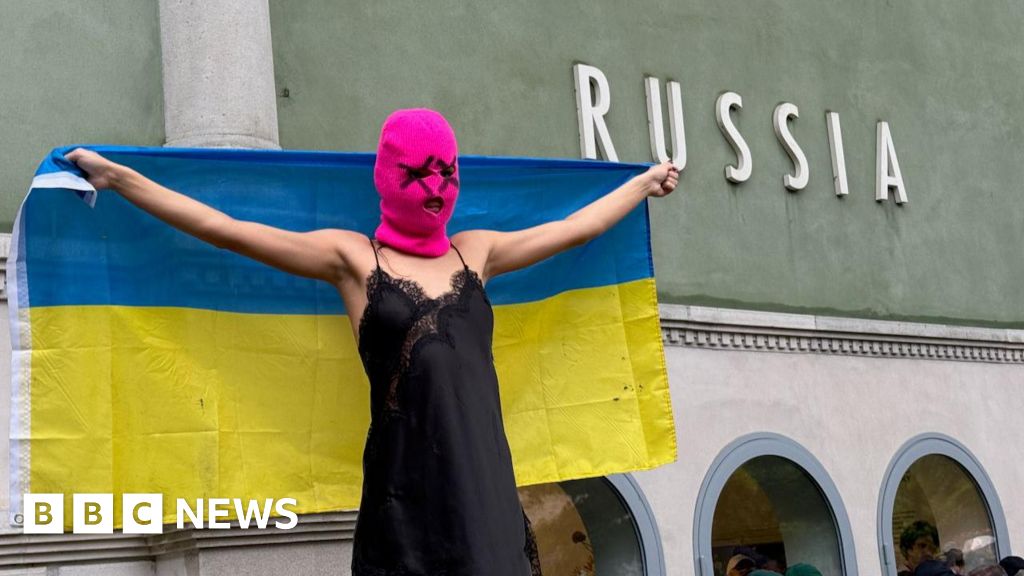
Pussy Riot and Femen activists staged a joint protest at the Venice Biennale as Russia returned to the arts event for the first time since its full-scale invasion of Ukraine.
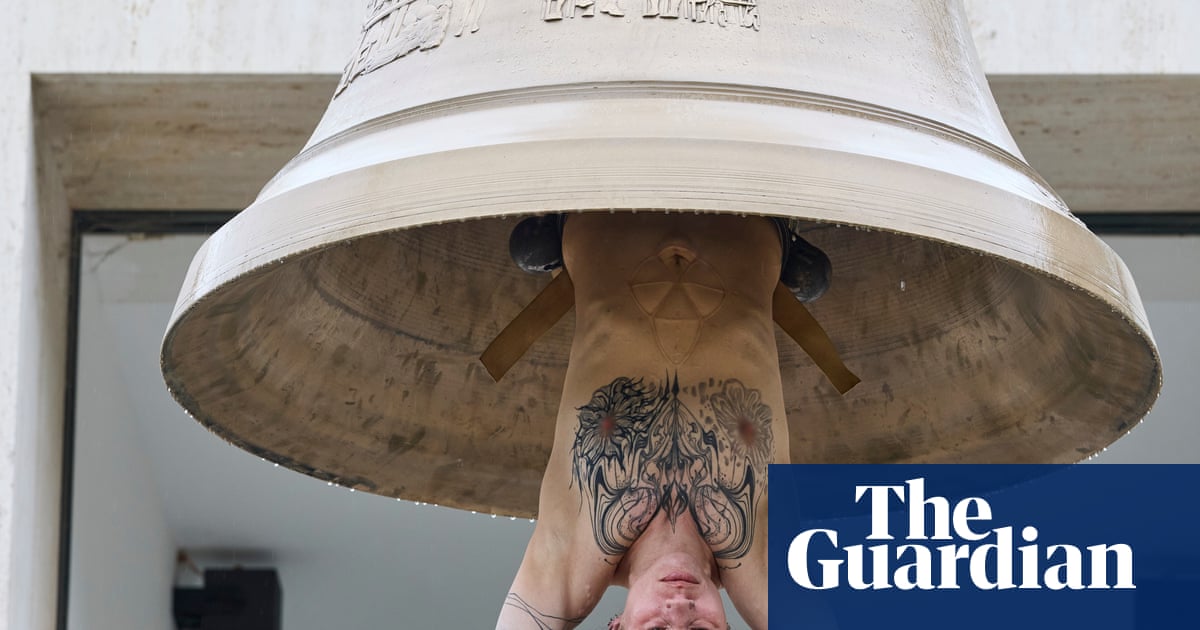
The groups, with Pussy Riot from Russia and Femen founded in Ukraine, moved through the Biennale gardens shouting outside the Russian national pavilion. Dressed in black with fluorescent pink balaclavas, they set off smoke flares and yelled "Russia kills! Biennale exhibits!" as security guards shut the glass doors. One poster read: "Curated by Putin, dead bodies included."
"They're drinking vodka and champagne in their pavilion, soaked in the blood of Ukrainian children," Pussy Riot member Nadya Tolokonnikova said. She called Russia's participation part of its hybrid warfare. "It's not just tanks and drones, murder and rape in Ukraine. It's also culture, art, language…it's the way [Russia] tries to conquer the West and you guys just opened the doors to them."
Moscow announced Russia's reinstatement earlier this year, drawing concern. The European Commission strongly condemned the decision and threatened to pull €2 million ($2.2 million) in funding, saying allowing the aggressor Russia to shine on the platform violates ethical standards tied to the grant.
Italy's culture minister will skip the fair's public opening on Saturday. Deputy Prime Minister Matteo Salvini, who visited Red Square in 2014 wearing a Putin T-shirt, refused to join the boycott. "No pavilion should be excluded," he said. A Brussels source said the Commission was unimpressed with Italy's stance.
Controversy surrounds the 61st Biennale beyond Russia. Last week, the international jury resigned after a statement mentioning countries with leaders wanted by the International Criminal Court for suspected war crimes, including Russia and Israel.
On Wednesday, protesters targeted the Israeli exhibit, covering the floor outside with rain-soaked leaflets calling it a "Genocide Pavilion." Israel's foreign ministry has criticized a "political jury" for turning the Biennale into a site of "anti-Israeli political indoctrination."
Biennale president Pietrangelo Buttafuoco, a right-wing former journalist who has praised Vladimir Putin, accused critics of fostering a "laboratory of intolerance" through calls to ban Russia and Israel. "If the Biennale began to select not works but affiliations, not visions but passports, it would cease to be what it has always been: the place where the world meets," he said before leaving a press conference.
Posters around Venice promoted an "Invisible Pavilion" for Ukrainian artists like Volodymyr Vakulenko, stamped "Cancelled. Because the author was killed by Russia." Russian troops shot Vakulenko when they occupied his village.
The Biennale's canal-side gardens host dozens of national pavilions that serve as soft-power showcases, especially for autocracies like Russia. In 2022, Russian curators withdrew in protest over the Ukraine invasion, and the pavilion went to Bolivia. This year, a Russian team installed an upside-down tree and sound performances.
"This is our house, we come to our place," pavilion commissioner Anastasia Karneeva said when asked about Russia's participation during the invasion. "I don't think about the protests. I am very busy." She declined to discuss her father, deputy head of state weapons producer Rostec, which faces sanctions, and ended the interview.
Russia's return is partial: the pavilion will close after pre-opening events. It is unclear if protests or sanctions prompted this. Recordings of the performances will screen outside for the public, carrying sound toward Ukraine's pavilion.
Near the main entrance, Ukrainian artist Zhanna Kadyrova's concrete origami deer sculpture hangs from a crane on thick straps. First installed in Pokrovsk in eastern Donbas when the front line was almost 40 kilometers away, it now represents loss. "Pokrovsk [is] now an occupied city. A lot of people were killed there. But we saved this artefact. The question is how many artefacts were not saved in this war? How many other kinds of heritage were destroyed?" Kadyrova said. "This was a lively city. And it does not exist now because Russia came."
Additional reporting by Davide Ghiglione.
What's Your Reaction?
 Like
0
Like
0
 Dislike
0
Dislike
0
 Love
0
Love
0
 Funny
0
Funny
0
 Wow
0
Wow
0
 Sad
0
Sad
0
 Angry
0
Angry
0


Comments (0)