

Panthalassa Raises $140 Million to Build Wave-Powered Floating AI Nodes

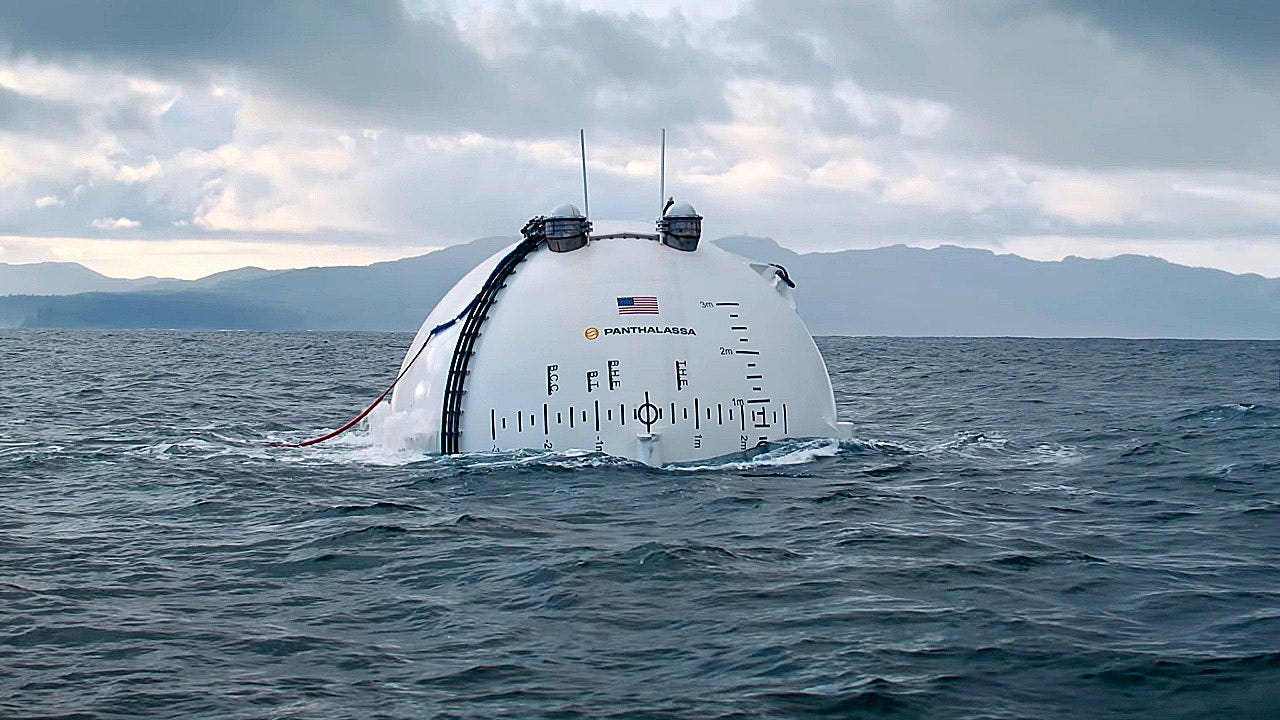
Panthalassa has raised $140 million in a Series B funding round to develop and deploy autonomous floating AI computing nodes powered by ocean waves. The investment brings the company's total funding to $210 million. Peter Thiel, co-founder of Palantir, led the round. Panthalassa will use the money to complete a pilot manufacturing facility near Portland, Oregon, and deploy its Ocean-3 pilot node series in the northern Pacific Ocean later in 2026.
The startup aims to place computing power at sea instead of building more land-based AI data centers. Ocean waves would generate electricity for the nodes, while seawater provides cooling. Onboard systems would process AI prompts and send results to land via low-Earth-orbit satellites.
Panthalassa's floating nodes capture wave motion to produce power. The company spent a decade developing technology for power generation, onboard computing and autonomous ocean operations. It tested Ocean-1, Ocean-2 and Wavehopper prototypes in 2021 and 2024. Each node functions like a floating power station with AI hardware. Wave motion drives generators that power the chips.
The nodes target AI inference, where trained models respond to prompts. That process suits floating setups better than training, which demands massive data movement and coordination.
AI data centers require vast electricity, space, cooling and local support, challenges that spur offshore ideas. Panthalassa's nodes would operate far from shore in wave-rich ocean areas, converting wave energy to onboard power. "We've built a technology platform that operates in the planet's most energy-dense wave regions, far from shore, and turns that resource into reliable clean power," said Garth Sheldon-Coulson, Panthalassa's co-founder and CEO.
Cold ocean water aids chip cooling, a key data center issue. Unlike grid-dependent land centers, these nodes generate their own power from waves.
Satellite links pose a challenge. Land centers use fast fiber optics, but offshore nodes rely on slower low-Earth-orbit satellites. Multi-node coordination for AI tasks grows harder with satellite delays. Sea-based centers may suit self-contained inference rather than replacing land facilities soon.
Repairs add difficulty. Technicians can reach land centers easily, but ocean nodes demand ships, equipment and good weather. Saltwater corrosion, storms and constant motion stress hardware. Panthalassa develops autonomous systems for harsh conditions. Ocean-3 tests aim to prove AI inference and refine manufacturing ahead of 2027 commercial deployments.
Ocean data centers have precedents. Microsoft tested underwater servers in Project Natick in 2015 and 2018, finding lower failure rates than land systems with seawater cooling before ending the project. Chinese firms pursued underwater centers near Hainan and Shanghai. Keppel explored floating designs in Singapore. Panthalassa differs by pairing wave power, onboard AI chips and satellite returns in remote floating nodes.
What's Your Reaction?
 Like
0
Like
0
 Dislike
0
Dislike
0
 Love
0
Love
0
 Funny
0
Funny
0
 Wow
0
Wow
0
 Sad
0
Sad
0
 Angry
0
Angry
0








Comments (0)