

Nasa picks Blue Origin and others to build lunar landers and rovers

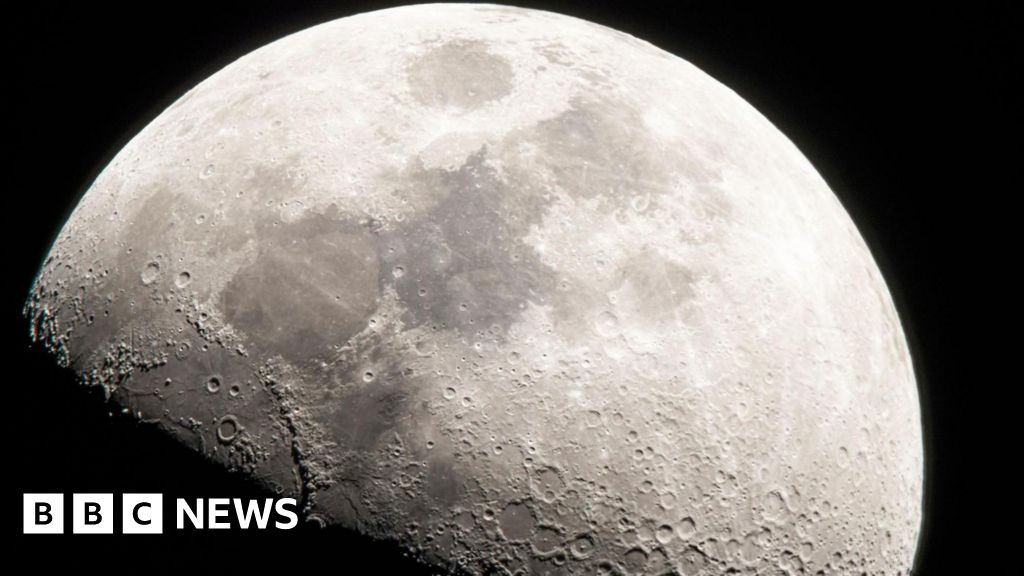
Nasa has released details of robotic landers, hopping drones and vehicles it plans to send to the Moon as part of US efforts to build a lunar base.
Amazon founder Jeff Bezos's space company Blue Origin is among several firms selected to build the machines.
The US wants to land Americans back on the Moon before President Donald Trump leaves office in 2029. Nasa is competing with China, which aims to land humans on the Moon by 2030.
On Monday, China launched its Shenzhou-23 spacecraft, sending a crew to the Tiangong space station.
In March, Nasa announced a $20 billion programme to build a permanent base powered by nuclear and solar energy at the Moon's south pole by 2032.
Nasa administrator Jared Isaacman said on Tuesday that the announcements mean the US will "never give up the Moon again."
A base would allow the US to conduct scientific experiments, mine resources and travel more easily to Mars. Most experts agree that Nasa's timeline is unrealistic.
Despite the success of the Artemis II mission in April, when four astronauts flew around the Moon, some scientists believe China is likely to be the next country to land humans on the lunar surface.
"It would not surprise me at all if China gets there first," said Dr Simeon Barber, a lunar scientist at the Open University.
Nasa's Ignition Moon Base programme has three phases. Before humans arrive, the agency wants to send robotic landers and hopping drones to explore and map the Moon's terrain. Delivery vehicles would also carry astronauts across the surface and transport communications and scientific instruments.
On Tuesday, Nasa said companies including Blue Origin, Intuitive Machines and Astrobotic have been awarded contracts to build the machines.
Blue Origin's lunar lander, called Endurance, is expected to perform precise landings and autonomous navigation. Astrobotic's Griffin-1 lander is set to touch down at Nobile Crater near the South Pole. The machines will also deliver high-resolution cameras and laser-based landing tools.
Carlos García-Galán, the Moon Base programme executive, said the robotic phase should run until 2029, with 25 launches and 4 metric tonnes of cargo landed on the Moon.
Next, Nasa plans to build nuclear and solar power facilities, including fission reactors. By 2032, the agency wants humans to live on the Moon in semi-permanent housing, with rovers allowing long-distance travel across the surface.
The Moon's south pole is of interest because frozen water could be used for drinking or to produce oxygen.
What's Your Reaction?
 Like
0
Like
0
 Dislike
0
Dislike
0
 Love
0
Love
0
 Funny
0
Funny
0
 Wow
0
Wow
0
 Sad
0
Sad
0
 Angry
0
Angry
0










Comments (0)