

Ecosystems have no functions of their own, philosopher argues

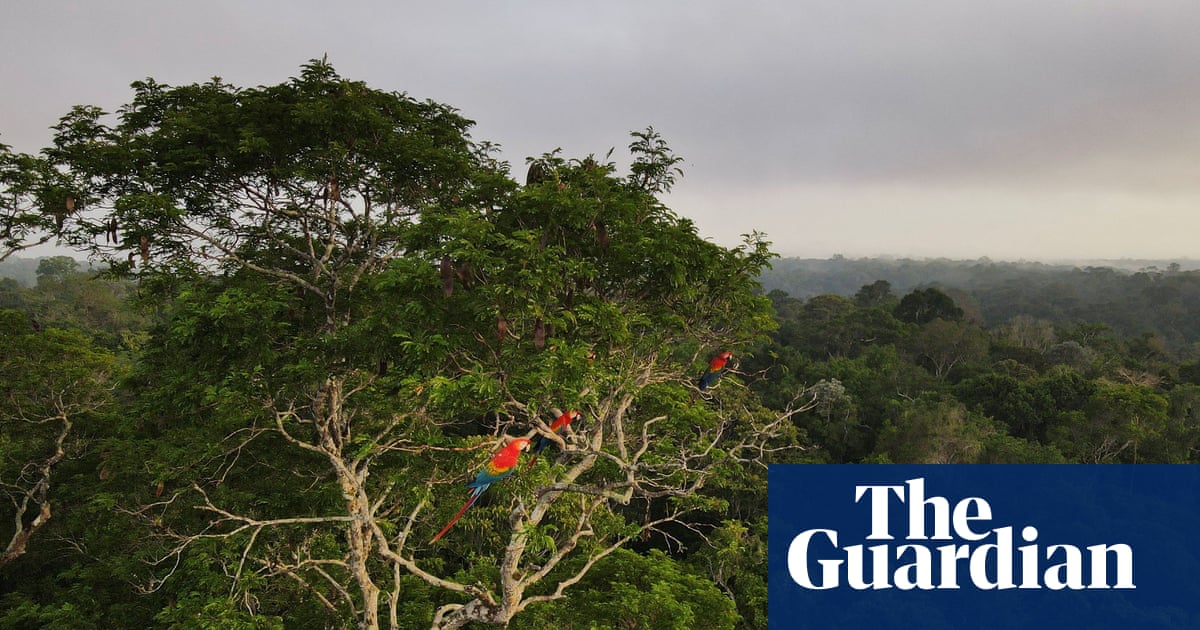
The Amazon rainforest is losing its capacity as a carbon sink and now emits more than it absorbs, according to a 2021 study. In the tropics, marine scientists report that coral reefs are in decline, threatening fish stocks. Research into the Atlantic Meridional Overturning Circulation, a system of ocean currents that helps regulate the climate, shows it is at risk of collapsing this century. The global ecosystem appears to be losing its ability to function.
Newspapers, magazines, technical reports and journals of learned societies often describe the environment in terms of its functions. Many people also think of forests as existing to produce oxygen, wetlands to filter water and bees to pollinate crops.
The problem with this way of thinking, according to a philosopher of ecology, is that ecosystems do not exist to perform goals. The Amazon absorbs carbon, but it does not aim to do so. It simply exists. Any standards of operation found in nature come from human desires for climate stability, abundant fisheries, beauty or cultural meaning.
The author came to this question as a graduate student in the late 1990s, when research into biodiversity and ecosystem function was increasing. He planned to write a dissertation on whether species richness drives productivity but instead earned a master’s degree in philosophy alongside his work in ecology. He found a debate over the concept of function in philosophy of science but saw little connection to how ecologists used the term. This essay attempts to bring those conversations together.
The author is an environmentalist concerned about the loss of natural places and, as a father, worried that his generation will leave children a planet depleted in richness and resilience. If the way people think about ecological crisis is conceptually shaky, he argues, it risks obscuring what is at stake.
Approaches to conservation have long been shaped by debates about whether nature has a purpose or whether people project their own aims onto it. In the 19th century in the United States and the United Kingdom, answers were rooted in game laws and hunting traditions that sought to maintain populations of species valued for sport or resource use. By the mid-20th century, Aldo Leopold proposed that the moral community should include soils, waters, plants and animals.
In the 1970s and 1980s, conservationists increasingly grounded their answers in the intrinsic value of specific species, reflected in legislation such as the US Endangered Species Act. A decade later, some researchers saw the species-focused approach as lacking because it targeted only rare organisms that contributed little to ecosystem processes. They worried that it overlooked services such as food production, clean water, drought mitigation, storm protection, timber and fibre.
In the late 1990s, this concern led to a new research agenda called biodiversity and ecosystem function. It presented itself as a scientifically rigorous framework and a justification for conservation that embraced all biodiversity rather than focusing on rare species. In the early 21st century, this logic scaled up to underpin UN projects and intergovernmental science policy. National governments began commissioning natural-capital accounts that assigned monetary value to pollination, flood regulation and carbon storage. The answer to the question of what nature is for became that nature is for the services it provides to people.
The idea of function now pervades how ecosystems are described. Anyone who has described a forest as a carbon sink or a wetland as a natural filter has inherited the logic of ecosystem services.
The word function sometimes refers to designed purposes, such as the function of a clock to tell the time. Other functions arise through co-option, such as using a rock to hold papers in place. Still other functions emerge without intention, as when penguins developed eyes optimised for underwater vision that leave them myopic on land.
Two main theories guide how scientists think about function. Causal role theory holds that ascribing function identifies a component’s contribution to the capacity of the system that contains it. Selected effects theory holds that a trait has a function because of the effect for which it was favoured by natural selection.
Causal role theory has limits. It provides no way to determine which processes count as genuine capacities rather than incidental effects. It also cannot account for malfunction, because it offers no standard for what counts as doing a job well.
Selected effects theory provides such a standard by anchoring function in evolutionary history. The question is whether ecosystems can have this kind of standard.
Ecosystems are not shaped by selection as cohesive units, do not reproduce and may not even be identifiable biological entities. They are open, dynamic systems composed of countless interactions among organisms and their local environments. Ecologists continue to borrow the language of function to describe processes such as wetlands filtering water or forests storing carbon.
The journal Functional Ecology was founded in the 1980s. Articles began investigating how species use functional traits to influence ecological processes. Vultures scavenging carcasses, for example, can be described at the ecosystem level as contributing to nutrient cycling and decomposition.
Once species are assigned roles this way, descriptions of how biodiversity shapes processes can merge with judgments about what those processes are for. A decline in insect populations can be described as a change in pollination rates or as a loss of the ecosystem’s ability to support crops. The distinction between describing how something happens and making normative judgments about what the resulting processes are for matters when thinking about ecosystem change.
The selected effects account does not apply to ecosystem processes because ecosystems are not shaped by natural selection as cohesive units. Plants fix carbon and microbes decompose organic matter, but these processes can be described without claiming that a rainforest is for storing carbon. Any such claim is anthropocentric.
Peter Calow, founding co-editor of Functional Ecology, said he was comfortable with the notion of function applying to adaptation within species through natural selection but less comfortable with it being applied to ecosystems. The British Ecological Society’s publications committee debated the matter before adopting the title.
The 1993 book Biodiversity and Ecosystem Function grew out of a 1991 symposium supported in part by Unesco’s Man and the Biosphere programme. In the foreword, Paul Ehrlich wrote that of special interest to humanity is the relationship of biodiversity to the variety of services provided by ecosystems and to the stability of the flow of those services. He revisited the rivet popper analogy, in which each species is like a rivet in an aeroplane wing. The metaphor is rhetorically powerful but imperfect because rivets are static and placed by design, while species are dynamic and unique.
During recent decades, framing biodiversity loss as losing rivets has done political work by making stakes vivid for policymakers. It also aligns with the ecosystem services agenda. In this context, ecosystem function becomes a conceptual hinge that can be presented as a scientific measure while serving as a proxy for benefits to people.
Ecosystems can only malfunction when they are appropriated or co-opted for human purposes. If a wetland is designated as a water filtration system, a disruption in its ability to filter water can be seen as a malfunction. If a forest is managed for carbon sequestration, a decline in its carbon storage capacity can be considered a failure. These malfunctions reflect human values rather than intrinsic properties of ecosystems.
Ecologists could focus on characterising interactions in an ecosystem and quantifying changes of state without reference to purposes or goals. This approach respects the autonomy of the nonhuman world. Human values still guide what scientists choose to study. Recognising that value-free science is a myth does not weaken the case for environmental action. It clarifies that thinking about ecosystems and obligations to them is both descriptive and normative.
When people say natural systems exist to provide services such as oxygen or climate stability, they appropriate certain processes for their own purpose and privilege one process over others. These functions become selected effects because they persist because they are chosen by people in the present.
Ecosystems cannot malfunction on their own. They may change, reorganise or collapse, but these should be understood as natural processes, not failures. Teleological framings can be used only if it is explicit whose needs are being served and to what ends. Environmental arguments often present purposes as if they were natural facts rather than human commitments. When people say an ecosystem is breaking down, they risk disguising their own values as properties of the world.
By reframing understanding of ecological functions and malfunctions, it is possible to advance a more rigorous ecology that states reasons for caring about ecosystems directly. The work ahead is not to repair nature’s purposes but to take responsibility for human purposes and for the world they shape.
What's Your Reaction?
 Like
0
Like
0
 Dislike
0
Dislike
0
 Love
0
Love
0
 Funny
0
Funny
0
 Wow
0
Wow
0
 Sad
0
Sad
0
 Angry
0
Angry
0





Comments (0)