

Bank of England expected to hold rates at 3.75% amid Middle East tensions

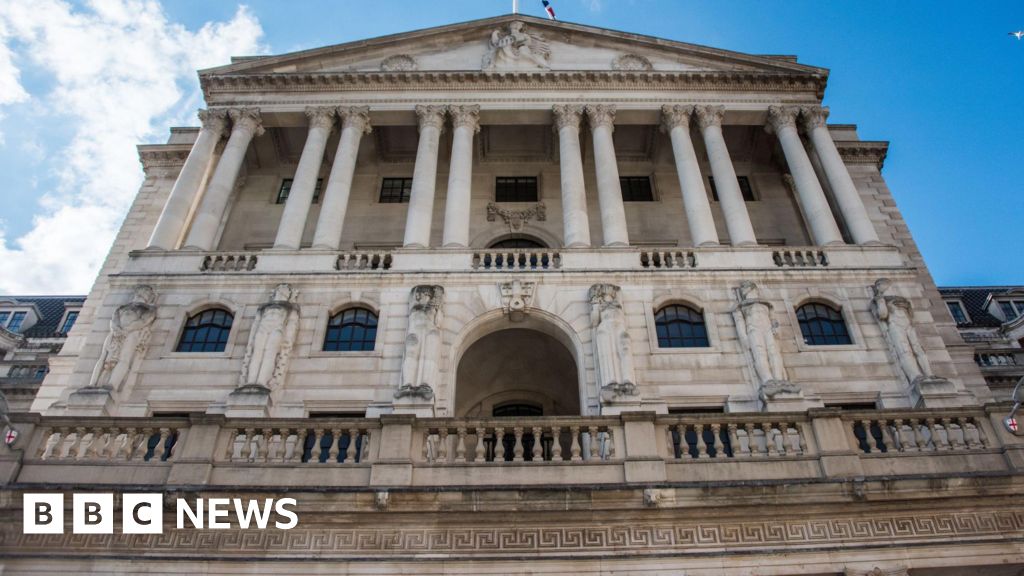
Policymakers at the Bank of England are expected to leave interest rates unchanged as they monitor developments in the Middle East.
Analysts widely predict that the Monetary Policy Committee will hold the benchmark rate at 3.75% for a fourth consecutive meeting.
Interest rates remain the main tool for controlling inflation, the rate at which prices rise.
UK inflation is still above the target level but has not climbed as high as many feared despite the global economic effects of the US-Israel war with Iran.
Official figures released on Wednesday showed inflation held at 2.8% in the year to May, with the pace of food price increases slowing to a 17-month low.
Transport costs rose at the fastest rate over the year to May, the Office for National Statistics said, while price increases for meat, dairy and vegetables eased.
The lower-than-expected figure has strengthened expectations that policymakers will not raise rates at the announcement due at 12:00 BST on Thursday.
At its April meeting, the MPC indicated that rates could rise this year to curb inflation after a significant energy price shock from the Iran war.
US President Donald Trump said a peace deal with Iran was signed on Wednesday and should allow the Strait of Hormuz to reopen.
Oil prices have fallen close to their lowest levels since the conflict began as traders expect ships to resume free passage through the waterway, which normally carries a fifth of the world's oil and gas supplies.
Analysts said price rises are still likely to accelerate in the UK because of the delayed effect of higher wholesale energy prices on household gas and electricity bills.
Millions of UK households face a 13% increase in energy bills from July under regulator Ofgem's price cap.
"UK inflation is expected to increase over the summer after the next Ofgem price cap in July, when we will likely arrive at peak inflation, so for now data looks like the calm before the storm," said Victoria Scholar, head of investment for Interactive Investor.
Some analysts forecast no further rate rises for the rest of the year, though the outlook remains uncertain.
Last week the European Central Bank raised its interest rate for the first time in almost three years, citing inflation pressures from the conflict.
The BoE's base rate is the rate it charges other banks and building societies to borrow, which influences mortgage rates and savings returns for their customers.
As of 17 June, the average rate on a new two-year fixed mortgage was 5.60%, up from 4.83% at the start of March when the Iran war began, according to Moneyfacts.
What's Your Reaction?
 Like
0
Like
0
 Dislike
0
Dislike
0
 Love
0
Love
0
 Funny
0
Funny
0
 Wow
0
Wow
0
 Sad
0
Sad
0
 Angry
0
Angry
0







Comments (0)