

Trump Blames Iran Infighting for Slow War Talks as Analysts See Regime Stability

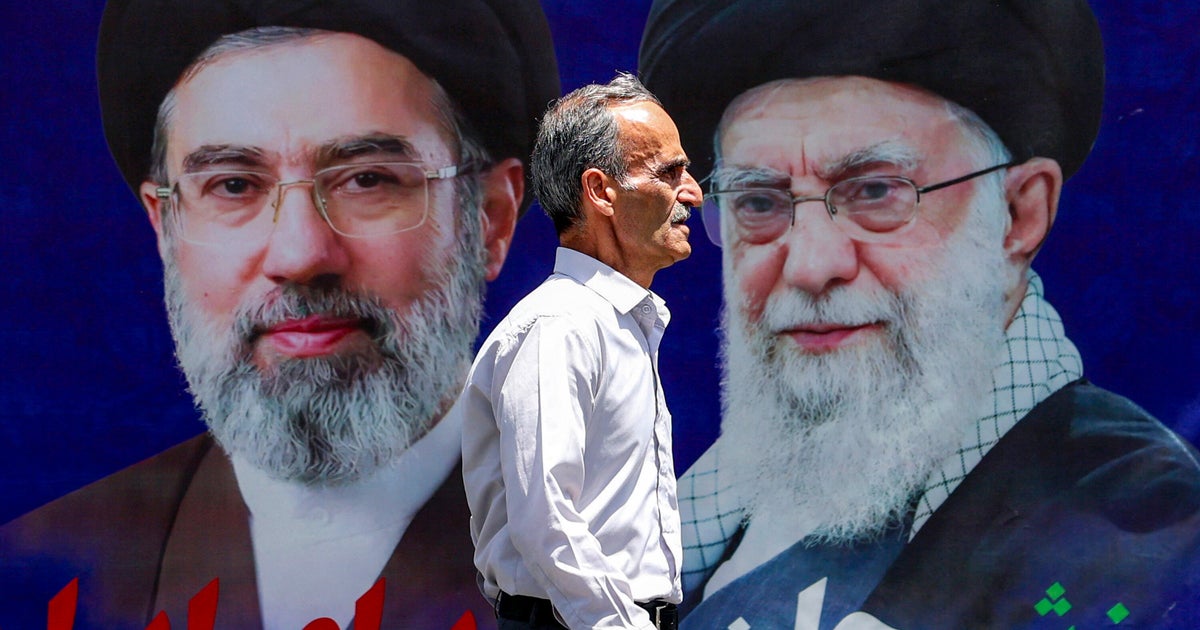
President Trump has said infighting and confusion within Iran's ruling regime partly explain the difficulty in striking a deal to end the war launched by the U.S. and Israel on Feb. 28.
Analysts told CBS News, however, that while power structures are shifting, little evidence shows divisions hampering Iran's leadership. They suggested Trump's rhetoric may aim to find a scapegoat as the White House struggles to present its policy objectives.
Trump said "nobody knows who is in charge."
A month after former Supreme Leader Ayatollah Ali Khamenei was killed in the first wave of U.S.-Israeli strikes on Iran, sparking a war that has shocked the global economy for more than two months, President Trump announced that regime change in Iran was "complete."
"The next regime is mostly dead," he said days after strikes began on Feb. 28, adding that U.S. negotiators were speaking to "a whole different group" of "very reasonable" people.
He changed course in recent weeks, attributing slow diplomatic progress on a deal at least partly to Iran's nearly five-decade-old theocratic regime being "seriously fractured" and in a "state of collapse."
"There is tremendous infighting and confusion within their 'leadership,'" Trump said in a late April social media post. "Nobody knows who is in charge, including them."
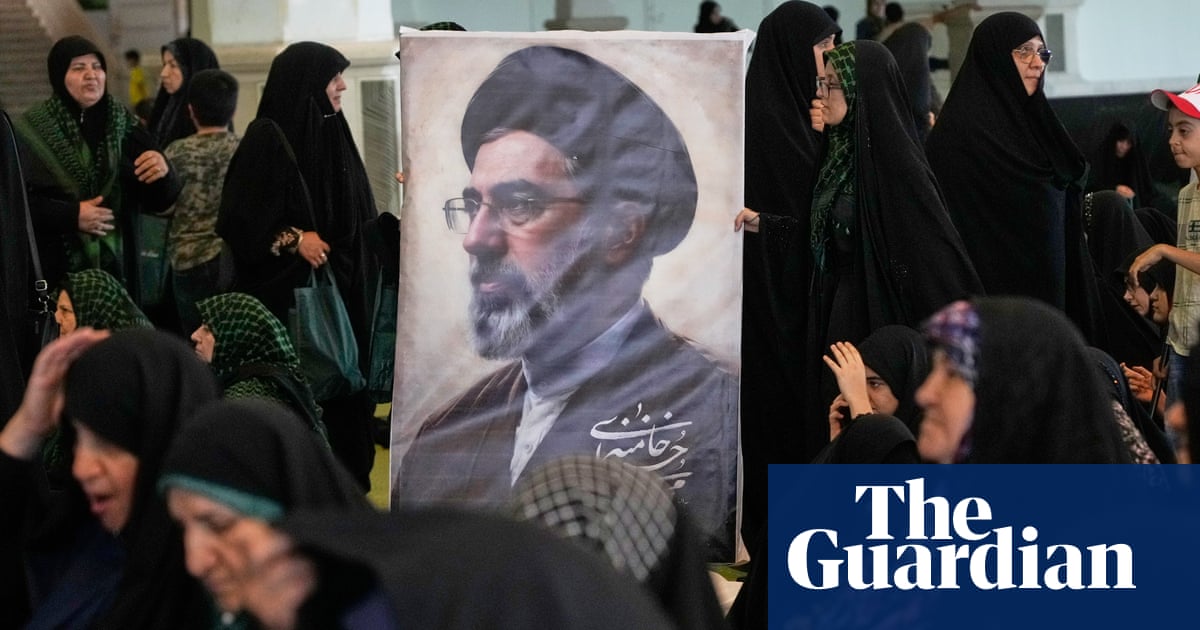
Ultimate political, military and religious authority has long rested with Iran's supreme leader. Iran named Ayatollah Mojtaba Khamenei as the new holder of that title soon after his father, Ali Khamenei, was killed in the first wave of strikes.
U.S. officials say the younger Khamenei was seriously wounded, possibly incapacitated, in the strike that killed his father. No independent confirmation of his condition exists, and he has not appeared or spoken directly since the announcement.
That invisibility initially fueled perceptions of a power vacuum. But the Islamic Revolutionary Guard Corps, an institution with longstanding significant power, may have quickly filled any gap in Tehran.
An Iranian transition "from divine power … to hard power"
The IRGC is a military, political and economic force that answers directly only to the supreme leader. It handles Iran's external military and paramilitary efforts, including ties with proxy forces across the Middle East, and enforces domestic security by quashing dissent.
A recent Reuters article, citing Iranian officials and analysts, said the new supreme leader's role was "largely to legitimize decisions made by his generals rather than issue directives himself." Power has coalesced around a wartime leadership contingent of the Supreme National Security Council, the supreme leader's office and the IRGC, which now dominates military strategy and key political decisions.
Sanam Vakil, director of the Middle East and North Africa program at London's Chatham House think tank, agreed that Iran is moving into a leadership transition. She told CBS News it could bring shifts in decision-making more broadly.
The change has brewed for decades, she said, as ruling clerics' 47-year grip loosened while the IRGC gained influence through business acquisitions and former members entering politics.
Aaron David Miller, a Mideast expert and senior fellow at the Carnegie Endowment for International Peace who served as a U.S. government negotiator, said on an April podcast that Iran has "moved from divine power … to hard power," with the regime now "tethered" to the IRGC.
Rumors have circulated of an IRGC coup, but that appears unlikely on the ground.
The IRGC derives authority from military strength and its deep connection to the supreme leader. Without that religious and ideological legitimacy, it might look to many Iranians like just another military branch, rather than defenders of the Islamic Republic, which a significant portion of the country still supports.
A regime factionalized "on tactics"
Iran's President Masoud Pezeshkian, whose office resembles the U.S. vice presidency and sits under the supreme leader, is seen as a moderate reformist. Many suspect he and other political figures favor returning to negotiations, fearing full-scale war with the U.S.
The IRGC has projected no weakness.
"If you attack the infrastructure of the Islamic Republic of Iran, our response will no longer be an eye for an eye, but rather a head for an eye," IRGC Major General Mohsen Reza'i, a military adviser to Khamenei, said in March.
Rumors describe a split between IRGC commander Brigadier General Ahmed Vahidi and Mohammed-Bagher Ghalibaf, the parliamentary speaker who led Iran's negotiating team in the only direct talks with U.S. officials since the war began. Those early April talks in Islamabad ended without converting the ceasefire into a wider peace deal.
On Monday, Foreign Minister Abbas Araghchi, also on the negotiating team, posted on X that "there's no military solution to a political crisis," possibly a jab at the U.S. and the IRGC.
Political figures like Pezeshkian and Araghchi have limited clout, however. Analysts say these opinion differences, more public now during the war, pose little threat to the regime.
Vakil told CBS News the regime is factionalized "on tactics, particularly with regard to the negotiations."
Thinly veiled jabs have flown between moderates and ultraconservatives over concessions to the U.S. The IRGC-linked Tasnim news agency published and deleted a late April editorial mocking ultraconservatives, comparing their expectations to a "magic beanstalk."
Ultraconservative cleric and parliament member Mahmoud Navabian criticized even holding talks as "pure damage," posting on X that "Iran's oil is selling for double the pre-war price" and implying war-end negotiators are "cowards."
Ultraconservatives form a small minority. Iran's parliament recently voted overwhelmingly to back the negotiating team.
Trump administration "a bit less aligned" than Iran's regime?
While competing viewpoints exist, Vakil told CBS News Tehran's political differences resemble Washington's.
Secretary of Defense Pete Hegseth focuses on a successful military campaign, she said, while Treasury Secretary Scott Bessent handles economic interests.
"So to me, this is all very normal," Vakil said, but in Iran "all of the different groups and individuals are aligned in the preservation of the regime and its security and stability."
Tehran's power evolution does not signal regime fragility. Experts told CBS News the White House may claim otherwise for its own reasons.
"While the Trump administration may have initially hoped for a 'Venezuela option,' featuring a Delcy Rodriguez-like figure stepping into leadership, no such option existed" in Iran, Mona Yacoubian, director of the Middle East Program at the Center for Strategic and International Studies, told CBS News.
"Instead, we have seen that initial decapitation strikes have led to an IRGC-dominated regime in Iran that has adopted a harder-line posture," she said. "The supreme leader no longer appears to have the final word on decision-making … Instead, decisions regarding Iran's negotiating posture with the United States appear to be taken by a collective group of IRGC leaders."
Vakil said Trump likely "exaggerated or misrepresented the divisions" in Iran "as an excuse" for negotiations that have not moved as quickly as he wanted on Washington's side.
"It's easy to blame it on [Iran]," she said.
Vakil said Iran's rulers have clear red lines and aims: regime survival through a permanent deal with guaranteed sanctions relief. The U.S., she added, has been a bit less aligned and clear.
What's Your Reaction?
 Like
0
Like
0
 Dislike
0
Dislike
0
 Love
0
Love
0
 Funny
0
Funny
0
 Wow
0
Wow
0
 Sad
0
Sad
0
 Angry
0
Angry
0


Comments (0)