

Ten of Sir David Attenborough's Best Documentaries

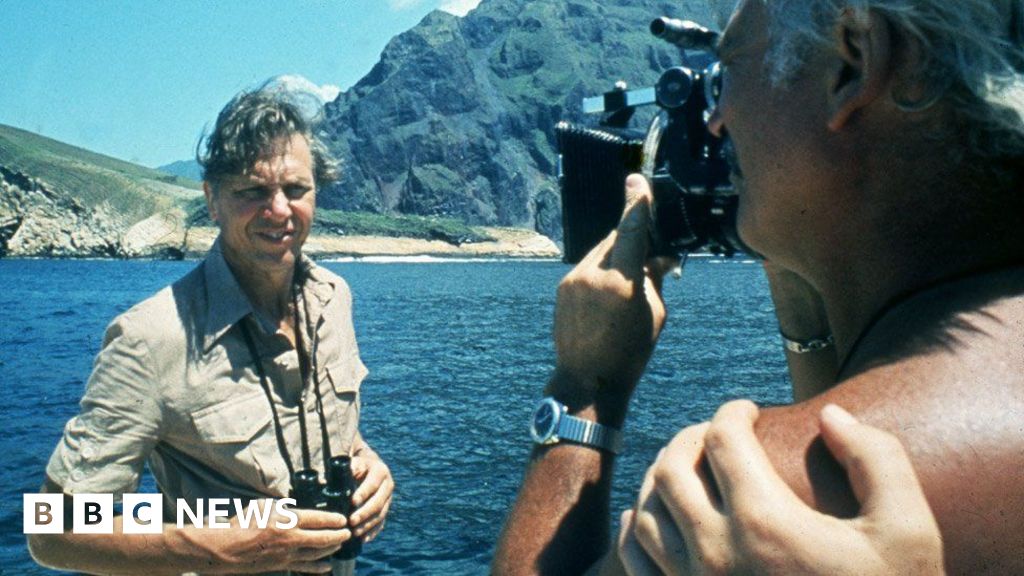
Sir David Attenborough's landmark natural history programs have educated and inspired audiences for more than seven decades. From encounters with primates to early climate warnings, here is a selection of his trailblazing programs and where to watch them in the UK.
Life on Earth (1979) was Attenborough's ambitious, globe-spanning effort to tell the story of life from the first primitive cells to the plants and animals that now live around us. It established Attenborough as the foremost TV naturalist and an iconic British cultural figure. Dr. Jean-Baptiste Gouyon, author of BBC Wildlife Documentaries in the Age of Attenborough, called it "absolutely groundbreaking for the time." He said it was the first series to send cameramen all over the world to capture images of animal behavior in the field. It was also the first with Attenborough talking to camera on location, rather than in the studio commenting on footage. "Life on Earth is the first on-screen appearance of David Attenborough as a character, rather than just as a presenter. It's the first for everything, basically," Gouyon said. The Bafta-nominated series drew up to 500 million viewers worldwide. It set the template for Attenborough's Life Collection, including The Living Planet, The Private Life of Plants and The Life of Birds. To mark his 100th birthday, the BBC released Making Life on Earth: Attenborough's Greatest Adventure.
The Trials of Life (1990) captured animal behavior from birth to death. Producers worked with scientists to uncover new stories. "For example, they got on film for the first time evidence of chimpanzees using tools," Gouyon said. The series also showed chimps working together to catch, kill and eat colobus monkeys, footage that was a first for wildlife television and had been debated in science circles. "They really worked with field researchers and filmed behavior which had never been seen before on television," he added.
The Blue Planet (2001) explored the world's oceans and their inhabitants, from deep-sea monsters to pack-hunting killer whales attacking a gray whale calf. It was the first comprehensive series on the natural history of the oceans, revealing life under the sea. "For the first time we were able to share the life experience of marine animals, which is something we could previously only imagine, and we're really deep in the middle of it," Gouyon said. "That's what made such an effect." Blue Planet II followed in 2017 and highlighted plastic pollution in the ocean that can throttle and poison creatures, including humans, as Attenborough told BBC News in 2019.
Planet Earth (2006) was filmed across 64 countries over five years and celebrated the natural world's variety. It was the most expensive nature documentary series commissioned by the BBC and introduced high-definition wildlife drama, like a polar bear battling a walrus. Blue Planet and Planet Earth brought a more cinematic sweep than earlier works, Gouyon said. "It's the quality and the scale of what was shown which was really groundbreaking," he added. Planet Earth II in 2016 featured snakes chasing iguanas and drew more young viewers than ITV's The X Factor.
Frozen Planet (2011) examined life in the Arctic and Antarctic and showed climate change's effects on the land and animals like penguins, fur seals and polar bears. A minke whale's escape from killer whales became an enduring image. In the final episode, On Thin Ice, Attenborough gave an impassioned speech on shrinking glaciers and rising temperatures. Frozen Planet II, a decade later, used racer drones to capture scenes like golden eagles pushing mountain goats off cliffs and killer whales hunting seals. It delivered a starker climate change warning.
Our Planet (2019) marked Attenborough's Netflix debut in an eight-part series with stunning imagery and conservation themes, made with the World Wildlife Fund. "It's an interesting one because it was the first natural history entirely devoted to addressing climate change," Gouyon said. Netflix reported 100 million households watched, though some in Spain and Latin America heard narration by Penelope Cruz or Salma Hayek. BBC arts editor Will Gompertz called it dazzling and said it carried Attenborough's hope for the planet.
Wild Isles (2023) turned Attenborough's focus to the British Isles in his mid-90s, breaking a BBC agreement from the 1950s to cover other nations. "The British Isles have astonishing scenery and extraordinary animal dramas and wildlife spectacles to match anything I have seen on my global travels," he said. Highlights included a white-tailed eagle catching a barnacle goose in mid-air, first filmed in the UK, and leaping Scottish salmon shot with underwater drones. Toadlets were swallowed by leeches with five pairs of eyes and three sets of teeth. Attenborough visited a puffin colony on Skomer Island off Wales, climbing 87 steps with a doctor and defibrillator. He also filmed in Dorset, Wiltshire and under a 700-year-old oak in Richmond Park, London. Wild London in early 2026 revisited the capital's urban foxes.
Ocean (2025), released in May, had Attenborough call the sea mankind's final frontier. "After almost 100 years on the planet, I now understand the most important place on Earth is not on land, but at sea," he said. He described it as one of his most important films, able to help save biodiversity and protect against climate change. The film presents the ocean as the planet's support system.
Secret Garden (2026) arrives as wildlife gardening gains importance. Producer Bill Markham said Attenborough's voice carries weight. "If Secret Garden succeeds in encouraging people to rethink what their gardens can be, it will be in no small part due to his influence and enduring credibility."
Gorilla Story (2026) revisits Attenborough's 1970s gorilla encounters from Life on Earth. The 77-minute Netflix film, directed by James Reed with Leonardo DiCaprio as executive producer, narrates the original group's story, including young gorilla Pablo, and their descendants' struggles. The Guardian gave it five stars, saying viewers would find themselves overcome with awe.
What's Your Reaction?
 Like
1
Like
1
 Dislike
0
Dislike
0
 Love
1
Love
1
 Funny
0
Funny
0
 Wow
0
Wow
0
 Sad
0
Sad
0
 Angry
0
Angry
0


Comments (0)