

Russian spy drones from Belarus rise sharply as Kyiv bolsters northern border

Russian spy drones flying into Ukraine from Belarusian airspace have sharply increased since the beginning of the year, as senior officials in Kyiv express mounting concern over Belarus’s involvement in the war.
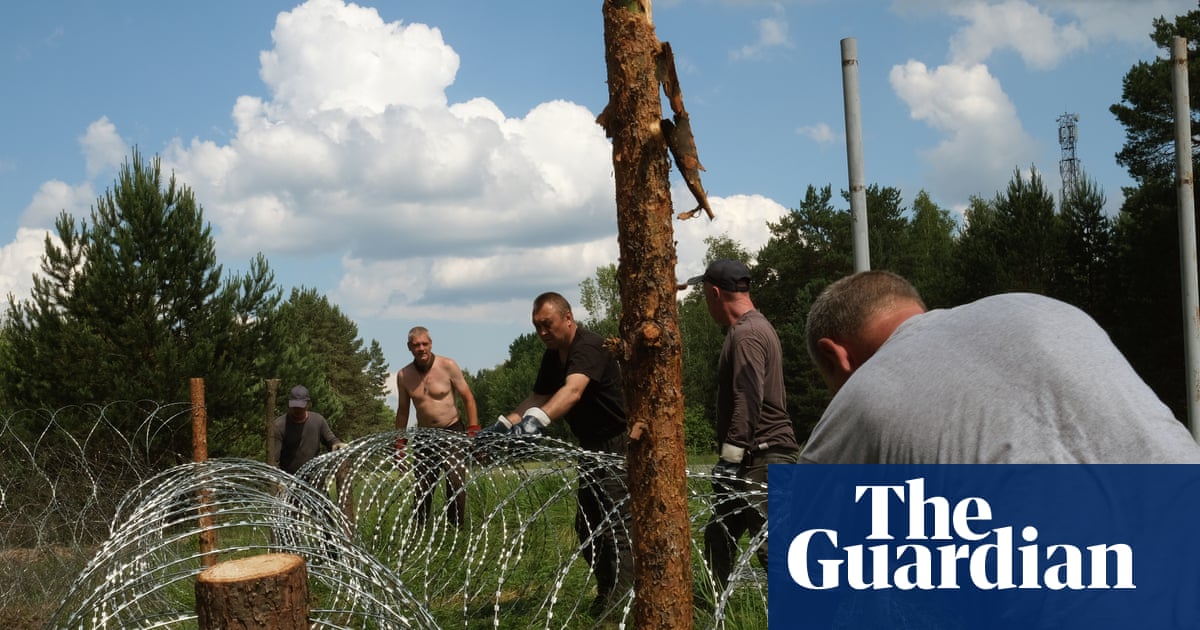
Ukraine has stepped up by reinforcing fortifications on its northern border, including anti-tank ditches, concrete “dragons’ teeth” obstacles to block armoured vehicles and new areas of barbed wire. Troops operating along the border say they have noted a jump of about 20% in Russian intelligence drones since January.
The increase in drone sightings comes in parallel with reports that Russia has constructed five new drone bases near its shared border with Belarus as part of its efforts to use Minsk’s airspace to attack Ukraine.
Ukrainian officials, including the president, Volodymyr Zelenskyy, have spoken of “unusual activity” on the Belarus border, amid concern that Moscow is seeking to draw its ally further into the conflict, and warnings that have been given to Minsk.
The claims came as Russia and Belarus on Wednesday accused Ukraine of conducting a deadly drone strike on a bus carrying Belarusian schoolchildren while visiting the Russian region of Bryansk, an allegation that Ukraine’s military said was “false”.
According to reports in May, Belarus has also been expanding infrastructure that could support Russian operations, including logistics routes and training grounds, as well as communications and surveillance infrastructure in support of Russian drone strikes into Ukraine, which use the Belarusian border areas as an air corridor for attack.
Officials say there is no evidence that Russian forces – or the Belarusian military – are gathering in large formations in border areas for a repeat of the use of Belarusian territory to invade Ukraine, as happened during the full-scale invasion in February 2022.
Instead, what concerns Ukrainian and European officials is that Moscow is attempting to integrate Minsk ever more closely into its war efforts, including through joint nuclear exercises earlier this year.
Among those who have flagged up concern over Belarus’s intentions is the former Ukrainian foreign minister Dmytro Kuleba, who also served on the national defence and security council of Ukraine.
In a recent television interview, Kuleba said that the Belarusian president, Aleksandr Lukashenko’s “actions today are different from 2022”, when he allowed his territory to be used by Russia for the invasion.
“I’m not saying that an offensive will begin tomorrow,” Kuleba said. “I’m saying I can see something different. A series of events unfolding that gives reason to believe Lukashenko is preparing for war.”
Other experts have noted an increase in pro-Russian messaging in Belarus, even as Moscow’s war against Ukraine increasingly has faltered. “Russia is in a strategic stalemate,” Maksym Pleshko, a Ukrainian politician and political scientist, told a recent expert roundtable on the Belarusian threat.
“Russia faces serious problems on the frontlines because we are beginning to win this war, and Lukashenko’s use of his narratives and propaganda is precisely an attempt to somehow justify and resolve this situation,” said Pleshko.
“And Putin is pressuring Lukashenko for greater cooperation, for greater involvement of his military system in the war against Ukraine, so Lukashenko is trying to justify this to his domestic audience.”
Others, however, including Yevhen Mahda, the director of Kyiv’s Institute of World Policy, are highly sceptical that Lukashenko would risk using Belarusian troops to support Moscow.
That was reinforced by warnings last month from Ukraine’s unmanned forces commander, Robert Brovdi, that Kyiv has already identified approximately 500 targets it would hit in the event of Minsk’s involvement becoming more direct.
“If we are talking about him [Lukashenko] involved in a potential action against Ukraine, politically it would be the end of him, not least after all that has been said about 500 targets in Belarus that Ukraine is ready to hit,” said Brovdi.
If there is broad agreement among experts in Ukraine and elsewhere, however, it is that Moscow – faced with a deepening impasse on the existing fronts in its war – may seek to use Belarus to threaten to widen the geographical scope of conflict against Ukraine, but also potentially in a wider European context.
It was precisely this point that was made by Ukraine’s foreign minister, Andrii Sybiha, in May. “Moscow is increasingly dragging Belarus into its war against Ukraine, turning it into a platform for aggression, not only against our country, but against Europe as a whole.”
And on Ukraine’s northern border with Belarus, Kyiv is not taking any risks regarding Minsk’s increasing participation in Moscow’s war.
North of the city of Chernihiv, occupied for a few brief months by Russian forces in 2022, sparsely populated villages are set amid forests of pine, silver birch and black alder. Here, along a narrow road leading to the border, a shirtless work crew fixes loops of razor wire while an excavator digs new anti-tank barriers.
Sitting in the parking area of a disused hotel and cafe 2km (1.2 miles) from Belarus, a major in Ukraine’s border force, who referred to himself by his military call sign, Nissan, is involved in improving the defences.
“There’s no secret that Belarus was a platform to invade in 2022, so there’s no trust of Belarus,” said Nissan. “We’ve seen a lot of statements from Lukashenko. We see joint training, including nuclear forces. We have to be ready for any scenario. So every day we are building our fortifications.
“With the landscape and what we have done, it’s my opinion it would be almost impossible for tanks and vehicles and infantry to move through here. Everything would be destroyed.”
While Nissan sees nothing to suggest any troop buildup, the evidence instead points to the Kremlin seeking to further exploit its key cross-border air corridor for strikes on Ukraine, including the creation of a large new base at Tsymbulovo in the Oryol region, which Russian sources suggest would be one of the world’s biggest.
And while Ukrainian forces have shot down more than 500 drones in the Chernihiv region alone since the beginning of the year, Russia is also intensifying its efforts to counter anti-drone and missile measures in this region.
“What we have seen,” said Nissan, “is an increase in the numbers of intelligence drones flying from Bryansk region [in Russia and into Belarus and then Ukraine] to collect data on our troops.” The trends have not gone unnoticed by local residents. In a shop in the village of Novi Yarylovychi, 5km from the border and home to about 300 people, Natalia Lanna, 55, and Svitlana Sotvykova, 57, see Russian drones daily.
“We had 16 go over yesterday evening in pairs,” said Natalia. “Sometimes they fly so low over the village, at 20-metres height, that it feels like I could catch them in my hands.
“We can tell the difference between the armed drones and the intelligence ones. We’re experts,” added Svitlana. “The day before yesterday, it was a Gebera surveillance drone. It’s a different sound. A different colour. They circle round.”
For some analysts, what residents and troops are seeing on the border represents the real meaning of the risk: not a sudden move by Moscow to open a new front, but an incremental widening of the scope of Russia’s activities involving Belarus.
“For European policymakers,” wrote Hanna Liubakova, a journalist from Belarus, in a recent paper for the Atlantic Council, “recent developments in Belarus create a different kind of challenge.
“This locks Belarus into a hybrid role that stops short of co-belligerent status, while deepening the country’s indirect participation in Russian aggression. For the Kremlin, this approach makes good sense. After all, Belarus is more useful to Moscow in the role of stable support base than as an unstable ally on the battlefield.
“The risk is not of sudden escalation, but rather of gradual normalisation. As Belarus becomes more embedded in Russia’s war effort, incidents linked to its territory, whether drone activity, airspace violations or other forms of pressure, are likely to become more frequent and harder to interpret.”
What's Your Reaction?
 Like
0
Like
0
 Dislike
0
Dislike
0
 Love
0
Love
0
 Funny
0
Funny
0
 Wow
0
Wow
0
 Sad
0
Sad
0
 Angry
0
Angry
0







Comments (0)