

Korean Artist Lee Ufan Turns 90 with Major Shows in Venice and New York

Naoshima, once polluted and dominated by a Mitsubishi plant, became Japan's 'art island' after billionaire Sōichirō Fukutake redeveloped it in 1989. The island in the Seto Inland Sea has 3,000 residents and features concrete galleries designed by Tadao Andō sunk into hillsides. These spaces hold contemplative works by artists from Claude Monet to Walter De Maria. A standout is Yayoi Kusama's giant yellow-and-black spotted pumpkin placed on a pier in 1994.
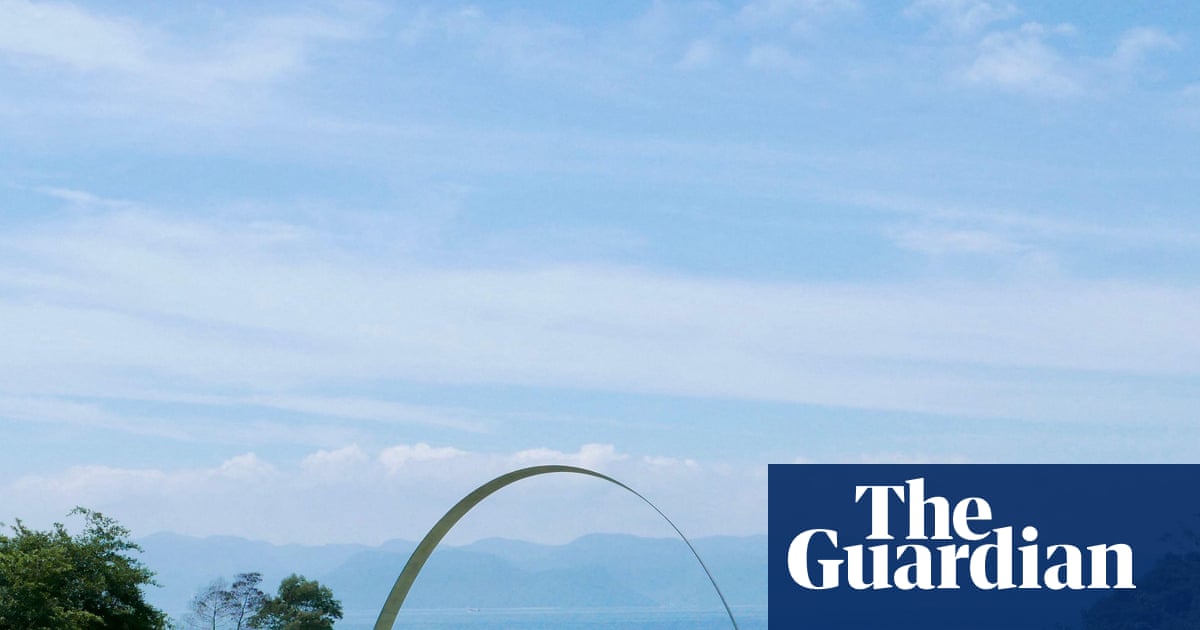
Retired American couples on dream trips call Naoshima the top spot for transcendent art. Many find it walking downhill to the coast, where a steel arch 11 meters tall and 13 meters wide sits between two sand-colored boulders. A long steel plate below invites visitors to pass through toward the sea.
The piece, Porte Vers l’Infini or Gate to Infinity, heightens the surroundings. The sky looks bluer, birdsong louder, pine-covered hills lusher. Creator Lee Ufan, born in Korea, said the next day at his Kamakura studio on the mainland: "I want my work to take you to a place where you can feel the deep breath of the universe."
Known as "Mr. Lee," the artist turns 90 next month. He has museums dedicated to him on Naoshima and in Arles, France. He opens two major shows soon: a Venice retrospective tied to the Biennale, covering his career from the late 1960s with early Mono-ha sculptures, and eight works at Dia Beacon in upstate New York.
Mono-ha, or School of Things, examined how objects relate in nature. Practitioners drew comparisons to American land artists, post-minimalists and Italian arte povera, which used soil, rock and sand. "I was in my early 30s," Lee said. "At that time, in the late 60s, America, Europe, and Japan were in a period of rebellion."
His first 3D piece, now called Relatum from Phenomenon and Perception B, featured a pane of glass cracked by a boulder, nodding to Marcel Duchamp and pitting industry against nature. "In the beginning," Lee said, "my work wasn’t about being slow or quiet. It was more about violence and resistance."
Lee did not always use heavy items. In a 1969 work then titled Things and Words, he chased three huge sheets of paper blowing across a square before Tokyo Metropolitan Art Museum on a windy day. "I wanted to show how we have a dialogue with material," he said. "Over time, the paper gets wrinkled and I become exhausted." It drew from Michel Foucault’s Les Mots et les Choses. "Maybe not," he added when asked if people understood.
Dia Beacon displays three sculptures and five paintings, including 1970s From Line pieces with fading dark blue stripes and 1990s With Winds swirls. Lee stopped the taxing From Line works in the 1980s due to hand tremors. Eight pieces may seem few, but his Naoshima museum has just 17, with no inside photos allowed.
Lee opposes overproduction in art and life. He once said: "I want viewers to perceive the things I did not paint as much as the things I did."
At Naoshima's Lee Ufan Museum, visitors end shoeless in a room with a curved white ceiling and pale wooden floor, contemplating three Dialogue series wall paintings. Each shows a gray lozenge from pale to dark, built from many small brushstrokes over a week. "My work is very powerful," Lee said. "It’s not my power, but it’s a vibration that happens in the relationship with the person who views it."
The day before his Venice opening, three journalists and I reached Lee's Kamakura studio, an hour's train from Tokyo plus a bus, slightly late. His manager ran up the hill urging us to hurry. Lee greeted us cheerfully in a gravel garden with sculptures like curving rusted steel by a boulder. He wore jeans, black leather slippers, a rust-colored quarter-zip knit and gray cardigan, looking far younger than his age.
"I just work hard," he said of his youthfulness. "I call myself a nomad – I travel a lot, visiting many other places and meeting many people. I still don’t understand the world and I want to know more. That probably gives me energy to stay young."
He rises at 7 a.m., walks an hour, buys fresh vegetables and gets acupuncture. Before painting, he does breath exercises for 10 to 15 minutes to quiet his body, using silence as a medium. He served tea in cups with his brush strokes. The studio holds brushes of all thicknesses, books on Richard Serra, Jasper Johns and land art, and From Line paintings, even in the bathroom. An interpreter and one of his three daughters joined; he noted his family sacrificed for his work. "I always talk about connecting to nature and through that, connecting to the art. But then I am, in a way, self-centred, so there’s an irony in that."
Born in 1936 in a Kyongsang-namdo mountain village during Japanese occupation of Korea, which ended after World War II amid civil war and partition, Lee shone in poetry, art, calligraphy and music. He studied music in Seoul aiming to compose.
At 20, he went to Japan with medicine for an uncle and stayed to study philosophy at Nihon University in Tokyo. His early art drew harsh criticism, so he wrote as defense. Stunned by Nobuo Sekine’s Phase: Mother Earth – an 8-foot earth column beside its hole in Kobe’s Suma Rikyu Park – he joined Mono-ha. He has written 17 books on philosophy, poetry and art history.
His fame grew internationally, but in 1970 New York organizers barred him from a Japanese art festival for being Korean-born, reflecting enmity. "I was a bit hurt," he said. "But I felt I needed to seek out ways to communicate with people who have opposite positions." Now a Korean in Japan with a Paris home and multiple languages, he values his borderless view.
Viewers may question his boulders' placement or a concrete pole on pebbles at his museum entrance, but they prompt contemplation of interior-exterior links, body in nature and self amid noise. "My work always bridges to something," he said. "Being open to connecting with others is so important."
What's Your Reaction?
 Like
0
Like
0
 Dislike
0
Dislike
0
 Love
0
Love
0
 Funny
0
Funny
0
 Wow
0
Wow
0
 Sad
0
Sad
0
 Angry
0
Angry
0



Comments (0)