

Genesis AI Unveils GENE-26.5 Robotic Brain for Human-Level Manipulation

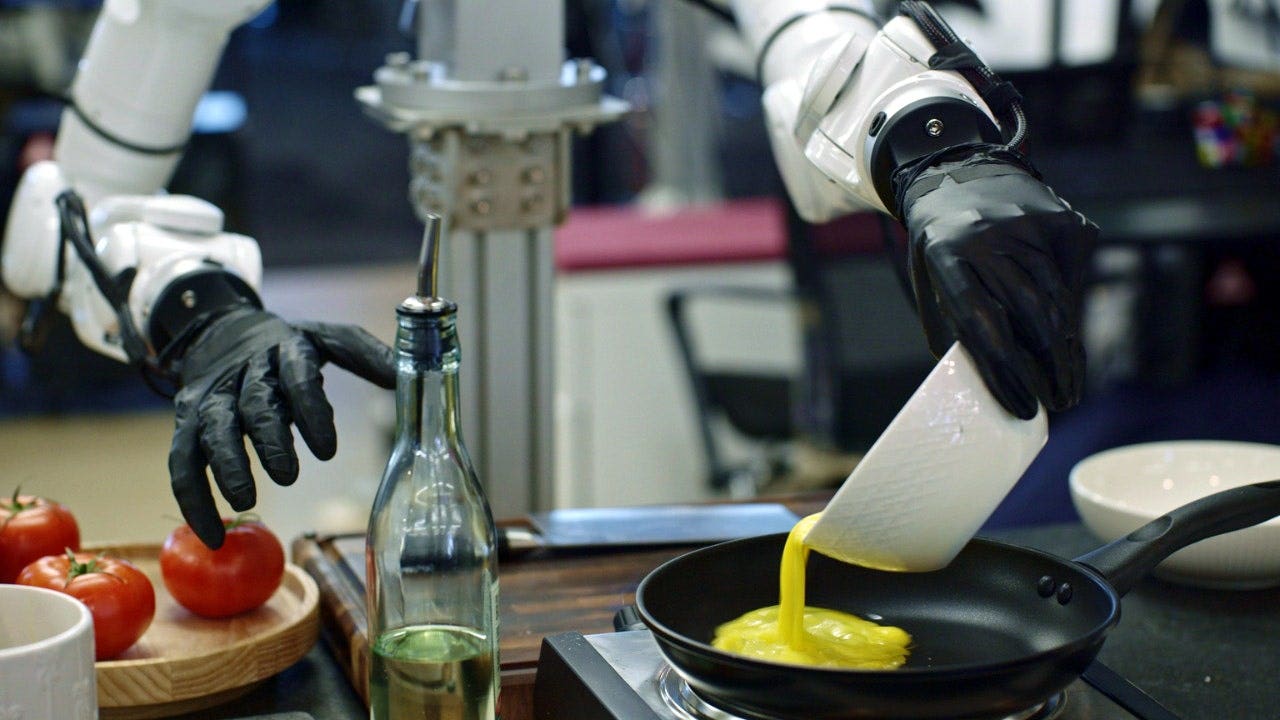
Genesis AI, a global full-stack robotics company, unveiled GENE-26.5, a robotic brain designed to help general-purpose robots perform complex physical tasks with human-level manipulation.
The system pairs a robotics foundation model with a human-scale dexterous robotic hand and includes a new data engine. These components allow robots to learn from human movement and handle tasks requiring precision and coordination.
Theo Gervet, co-founder and president of Genesis AI, described GENE-26.5 as the system guiding the robot's actions. "Think of GENE-26.5 like a robotic brain that takes in information and tells the robot what to do," Gervet said. "It is the industry's most advanced robotic brain, with the most advanced capabilities. We've proven this by releasing a few videos showing GENE-26.5 powering the most complex tasks ever performed by robots."
Most robots still struggle with detailed hand movements and repeat single tasks in controlled settings, but real life is less predictable. "We've developed a way to feed GENE-26.5 massive amounts of data about how human hands move, so it can tell our robotic hands exactly how to move like a human's hands," Gervet said. "GENE-26.5 can also tell our robotic hands how to do tasks with many, many steps."
For example, robotic hands powered by GENE-26.5 can follow a 20-step process to make a full omelet from start to finish. "That's why we're obsessed with innovating across the full-stack, from AI to hardware," Gervet said. "By controlling every layer, we can build a cohesive system and solve the problem holistically. Our approach gives us a huge competitive advantage by harnessing unprecedented amounts of data, as that ultimately defines what foundation models can achieve."
Human hands constantly adjust, even during simple actions. Gervet used a Rubik's Cube as an example. "Imagine you're playing with a Rubik's Cube. You have to hold it with the perfect grip strength. If you grip it too loosely, you'll drop it," he said. People make small adjustments without noticing. "You may not even realize it, but your brain is taking notice of how the cube feels. Even if you're just holding the cube, your hands are never perfectly still."
"They're constantly making micro adjustments to make sure the cube doesn't slip and stays balanced," he said. "It takes a lot of complicated, intentional and coordinated movements that involve over 20 joints in your fingers, knuckles and wrists. Our robotic hands can do exactly that."
Genesis AI built a robotic hand that mirrors the human hand in form and function. It pairs with a glove that captures motion and pressure. "The glove system helps us directly transfer information about how human hands move to our robot hands," Gervet said. When a human wears the gloves while interacting with objects, the system captures details about exact movements of fingers and wrists. The robotic hands match human hands, so the data transfers well.
Genesis AI says the glove is 100 times cheaper than typical options and shows up to five times greater data collection efficiency compared with traditional methods.
Robots have lacked usable training data for physical tasks. "Robots have always had a data problem," Gervet said. Unlike AI chatbots with access to the entire internet, robots faced challenges because human hand data did not translate well unless the robot's hand exactly matched a human's. "We've solved this problem by creating a robotic hand that exactly matches a human hand," he said.
In addition to glove data, Genesis AI uses videos from humans wearing camera headbands and massive amounts of internet videos. Its simulation system accelerates training in a fully virtual environment before real-world deployment, speeding up testing over traditional physical methods.
Genesis AI expects first use cases in workplaces such as warehouses and manufacturing facilities. "We see our technology being used in industrial settings to start and then later in the home," Gervet said. It can deploy for industrial use in warehouses and manufacturing logistics, with conversations already under way with industrial customers.
After the industrial phase, the technology could expand to the service industry and then consumers in homes. "In addition, we’re hoping that in a home setting, our technology will be able to help handle daily chores, freeing up time for people to spend doing what they actually enjoy," Gervet said.
Safety testing is core to development. "Our technology goes through extensive testing and validation, first in simulation running millions of scenarios, then in controlled real-world environments," he said. "It has to earn its way into the room." The company follows established safety standards and industry regulations.
Genesis AI is showcasing individual components, including the robotic brain, robotic hands and data collection system, and plans to unveil a full general-purpose robot. Early, small-scale deployments with select partners could begin later this year.
This technology will likely appear first in warehouses, factories and service environments with repetitive or physically demanding work. "In the future, we see our technology being able to fill some of the critical labor gaps there are today," Gervet said. "Our hope is that this will increase productivity, while creating space for people to focus on meaningful, creative and high-value work."
"The beauty of the technology is that it’s meant to fit seamlessly into the human world," he said. "Humans will still lead, but our reach won’t be limited by what we can do with our own hands."
What's Your Reaction?
 Like
0
Like
0
 Dislike
0
Dislike
0
 Love
0
Love
0
 Funny
0
Funny
0
 Wow
0
Wow
0
 Sad
0
Sad
0
 Angry
0
Angry
0








Comments (0)