

Francoist bars still operate openly in Spain despite new memory law

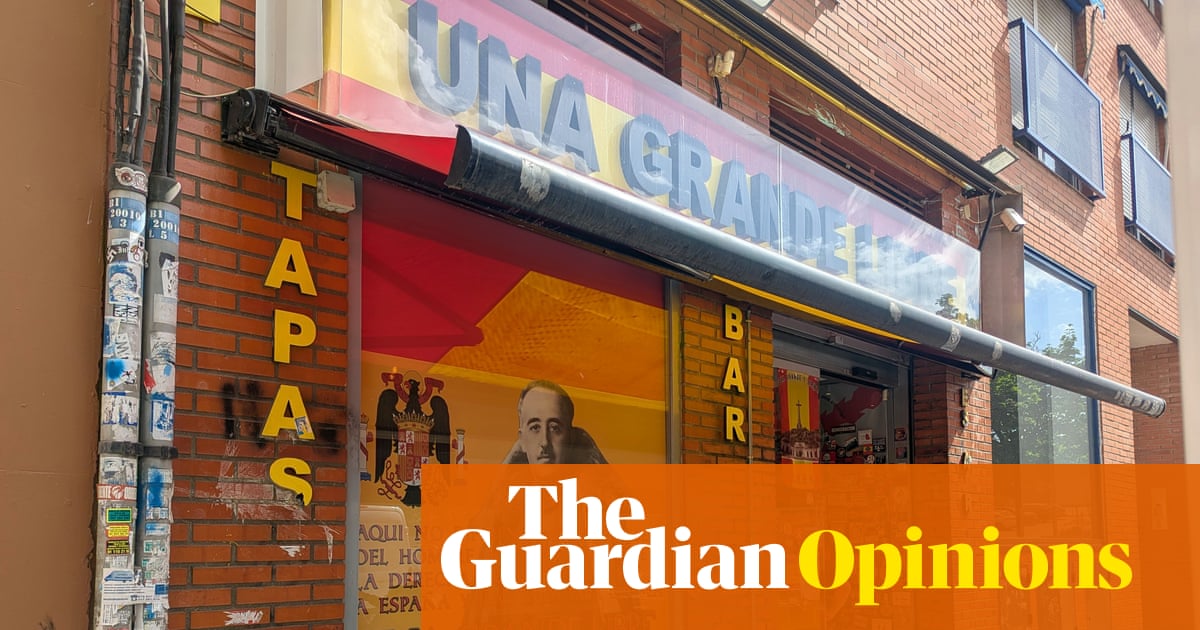
Una Grande Libre reads the sign above the entrance to a bar-restaurant in Madrid’s Usera neighbourhood. A large portrait of Francisco Franco is superimposed on the window.
The exteriors of El Cangrejo in Ciudad Real and Casa Pepe in Despeñaperros are decorated in the red and yellow of the Spanish flag. The yoke and arrows of the Falange and the Eagle of San Juan leave little doubt about the political message.
Portraits of the dictator are standard inside these restaurants. In Ávila’s El Rincón Nacional they sit on tables next to 1kg steaks. Una Grande Libre displays a stone bust of Franco and numerous pictures of him. Restaurante El Cangrejo has a version in which Franco has been edited into a Real Madrid shirt. After a meal, coffee comes with sugar packets that commemorate the 1981 attempted military coup. The Francoist anthem Cara Al Sol often plays on the speakers. Owner José Antonio Delgado answers the phone with the Francoist greeting “Arriba, España.”
Casa Pepe has a shop attached that sells cheeses, cured meats and memorabilia including tote bags printed with Franco’s face and tins of pimentón de la Vera designed like the Francoist flag.
Most of these establishments are roadside bars on motorways. They form part of Ruta 36, a highway route inspired by the year of Franco’s coup. Some offer a free meal to customers who collect stamps from each stop.
Una Grande Libre stands out because it is near central Madrid. Its owner, Xiangwei Chen, a Chinese immigrant, named his son Franco and has become known locally as el chino facha. Wine bottles in the bar carry that nickname.
Chen appeared in the news in 2019 when Franco’s remains were moved to Mingorrubio cemetery, eight years after the Zapatero government first proposed the relocation. The Valley of the Fallen, Franco’s previous burial site, had been marked by the world’s tallest cross and served as a shrine for the far right.
Chen received the title of “knight of honour” from the National Francisco Franco Foundation in 2016. The foundation, created after Franco’s death in 1975, received €150,000 in public grants during the José María Aznar government and enjoyed partial tax deductibility for donations. Abolition of the foundation was a goal of the 2022 Democratic Memory Law, which was finally signed last month.
The same law requires removal of symbols that glorify the dictatorship from spaces with public access, including bars and restaurants. Lawyer Eduardo Ranz said the Ministry of Democratic Memory has the power to open inquiries but has not acted against these establishments in four years.
Some progress has occurred. The Valley of the Fallen has been renamed and repurposed as a site of democratic memory, and a museum is planned. Fernando Martínez López, secretary of state for Democratic Memory, said last October that much work remains, including implementation in schools and recovery of bodies from mass graves.
A 2-metre portrait of Franco remains visible in a restaurant window in Madrid.
What's Your Reaction?
 Like
0
Like
0
 Dislike
0
Dislike
0
 Love
0
Love
0
 Funny
0
Funny
0
 Wow
0
Wow
0
 Sad
0
Sad
0
 Angry
0
Angry
0


Comments (0)