

European Leaders Gather in Yerevan for EPC Summit and First EU-Armenia Meeting

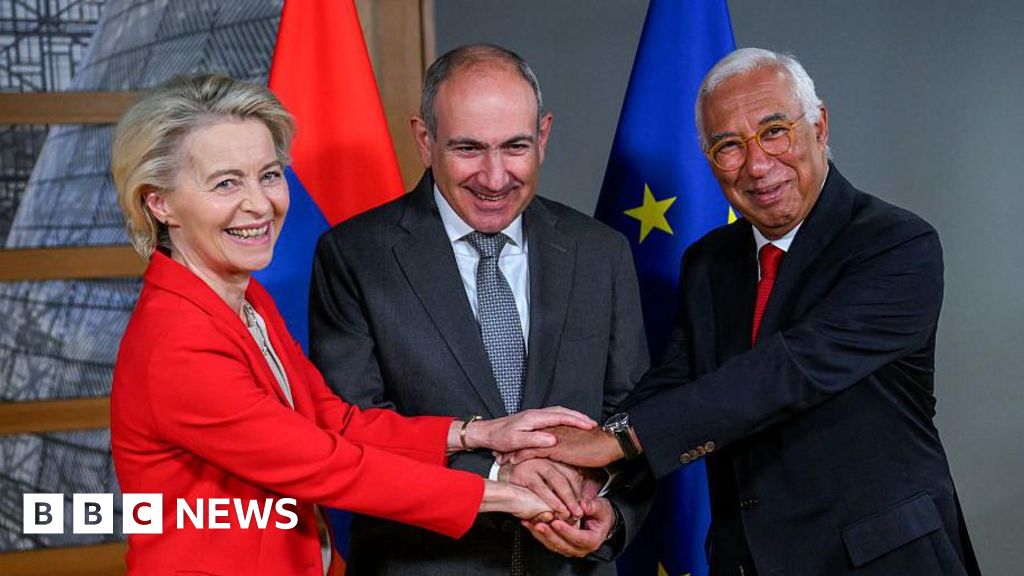
European leaders are gathering in Armenia for two summits in a nation long viewed as Russia's closest ally in the South Caucasus.
The event carries major weight for a country with fewer than three million people. Armenia belongs to Russian President Vladimir Putin's Eurasian Economic Union, and Moscow maintains a military base there.
On Monday, more than 30 European leaders and Canada's prime minister join a European Political Community summit in the capital Yerevan. Tuesday brings the first bilateral EU-Armenia summit, with European Commission President Ursula von der Leyen and European Council President António Costa in attendance.
Armenia relies on Russia for energy. It purchases Russian gas at a discount, as Putin emphasized during a visit by Prime Minister Nikol Pashinyan to Moscow on April 1. Russia sells gas to Armenia for $177.50 per 1,000 cubic meters, Putin said, compared to $600 in Europe. "The difference is large, it is significant," the Russian president added.
Armenia's path to hosting Europe's leaders traces to its 2023 war with Azerbaijan. Azerbaijan conducted a swift military operation to seize Nagorno-Karabakh, forcing out more than 100,000 ethnic Armenians. Russia, with peacekeepers in place, did not intervene. Prior Azerbaijani border incursions also drew no response from the Russia-led Collective Security Treaty Organization.
"We realised that the security architecture that we are in was not working," said Sargis Khandanyan, chairman of the foreign relations committee in Armenia's National Assembly.
The EU brokered a border recognition deal the previous year and stationed a civilian monitoring mission there. "The physical presence of the European Union shifted the perceptions of our citizens," Khandanyan said. "We realised there is a public demand for closer relations with the EU."
In March 2025, Armenia's parliament approved a law to begin EU membership proceedings.
Peace talks between Armenia and Azerbaijan have picked up speed. In August, their leaders signed an agreement at the White House to end decades of conflict. They also unveiled the Trump Route for International Peace and Prosperity, a corridor along Armenia's border with Iran to connect the region to European markets.
The peace remains shaky, and Europe's overtures to Armenia carry costs. Azerbaijan's parliament suspended ties with the European Parliament last week after a resolution called for Nagorno-Karabakh Armenians' right of return and the release of prisoners held by Baku.
Moscow views Armenia's EU ties with irritation. At the Kremlin, Putin smirked as Pashinyan noted full freedom for social media in Armenia, unlike Russia where major Western platforms are blocked. Putin told him EU membership clashes with Eurasian Economic Union rules. "It is not possible to be simultaneously in a customs union with both the European Union and the Eurasian Economic Union," he said. "It is simply impossible by definition."
Russia banned Armenian mineral water imports just before Monday's summit. "This is the hallmark of how hybrid threat works," said Artur Papyan of CyberHUB-AM, which tracks Armenia's information environment. Pro-EU remarks by officials or Brussels visits have led to Armenian trucks halted at the Georgian-Russian border and hacker threats against government sites.
Last month, the EU greenlit a new two-year civilian mission to Armenia to combat Russian disinformation, cyberattacks, and illicit finance, especially before June parliamentary elections. The mission mirrors one in Moldova ahead of its 2025 vote, where pro-EU groups retained power.
"I have studied those cases, especially the Moldova and Romania cases, also Ukrainian ones," Papyan said. "I can see there are common tactics, procedures."
In January, his group recorded a WhatsApp attack that hit several hundred thousand accounts, a tool used by government officials. Hackers also made a fake Signal account posing as EU Ambassador Vassilis Maragos to lure NGO leaders to a sham conference on Armenia-EU ties.
Ahead of the Yerevan summits, Papyan spotted six or seven Telegram spikes in one morning pushing claims that the events mark Armenia's break with Russia, inviting punishment.
Armenia has countermeasures, Papyan said, but they lag behind the threats' scale and skill.
European leaders offer civilian missions and visa liberalization within two years, but no EU membership date, defense pledges, or Russian gas replacement. Armenia's effort to balance Russia and the West continues.
What's Your Reaction?
 Like
0
Like
0
 Dislike
0
Dislike
0
 Love
0
Love
0
 Funny
0
Funny
0
 Wow
0
Wow
0
 Sad
0
Sad
0
 Angry
0
Angry
0

Comments (0)