

Xi Jinping Ends North Korea Visit With Vow to Deepen Ties

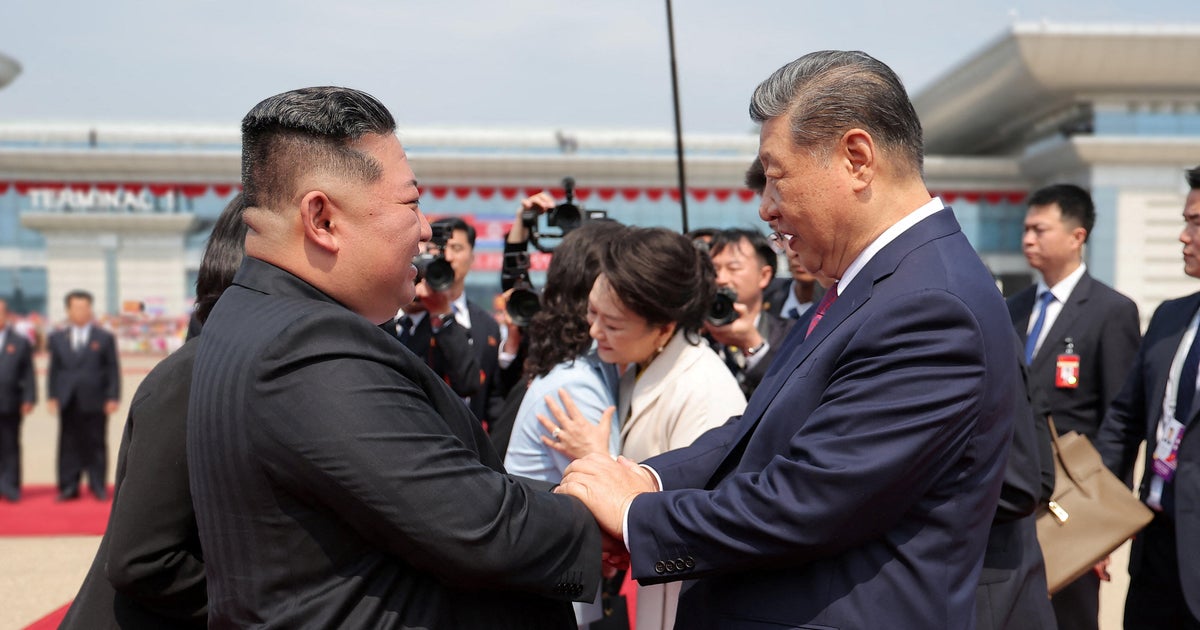
Hong Kong — Chinese President Xi Jinping ended a two-day visit to North Korea on Tuesday with a pledge to strengthen ties and expand cooperation with Kim Jong Un. Xi described the summit as a "new historical starting point."
Experts said the real purpose of the trip was to keep watch on an emboldened Kim, whose country now possesses nuclear weapons.
"Never before have the Chinese had to deal with a North Korea that has any swagger in its step," Bob Carlin, a former U.S. State Department official and North Korea analyst, told CBS News on Wednesday.
Carlin said North Korea has long felt "put upon by the big powers," but that is no longer Kim's view. "Since 2023, Kim has completely changed the center of the strategic policy of North Korea," he said. "For so many years it was to engage the U.S., normalize with the U.S. That's gone. They want to confront the U.S."
Carlin added that Kim sees himself "as a leader in this movement, and sooner or later he's really going to have a reckoning with the Americans."
That situation creates a problem for China, Carlin said, because Beijing knows any conflict between Kim and the United States would draw China in. "So they need to know what he's up to, and they need to be counseling him and holding him back when they can."
Relations between China and North Korea have been strained since Xi took power in 2012. Kim assumed control of North Korea a year earlier after the death of his father, Kim Jong Il. Carlin noted that Beijing had maintained closer ties with Kim's uncle, Jang Song-thaek, who was executed in 2013 on Kim's orders. Several years later, China supported United Nations sanctions against North Korea over its nuclear program.
Carlin said a "poisonous stream" still runs through the personal relationship between Xi and Kim, but both sides accept that they must live with each other as neighbors. "Things can get very bad sometimes, really nasty, but they have to come back to a certain type of equilibrium," he said. "It makes more sense for them to stand together and cooperate."
This week Kim called the relationship "rock solid," while Xi urged both countries to defend their sovereignty, security and development interests. The leaders discussed trade, economic partnerships, tourism, Chinese investment and education exchanges, according to official statements.
Carlin said the area of greatest concern is military cooperation. The 65th anniversary of a defense treaty between Beijing and Pyongyang next month could reveal how far the relationship has advanced, depending on what is announced.
Xi's visit was also viewed as an effort to counter growing Russian influence in North Korea. In exchange for weapons and thousands of North Korean troops, Russia has provided financial aid and recognized North Korea as a nuclear weapons state.
"China doesn't want Russia and North Korea off in a corner planning anything between themselves," Carlin said. Beijing wants "to be the control rod" and stabilize the situation.
Just days before Xi arrived, Kim unveiled a new nuclear production factory and visited a uranium enrichment facility. On the eve of the visit, Kim's sister Kim Yo Jong said North Korea's nuclear status is "irreversible."
Carlin said Kim is building new enrichment plants and producing plutonium. "So he is building up a nuclear arsenal which is really, really hefty," he said. Kim also has enough missiles to carry nuclear weapons across South Korea and Japan.
Carlin said Kim has three goals: to reduce U.S. standing in the world, to reunify the Korean Peninsula, and to be treated as a peer by China and Russia. "The Chinese can't do anything if they're on the sidelines, so they've got to get back into the game," he said.
The visit followed back-to-back summits in Beijing last month, when Xi hosted President Trump and then Russia's Vladimir Putin. Neither government has said whether Xi carried a message from the White House.
Trump and Kim met three times during Trump's first term. Since their last meeting in 2019, North Korea has tested more than a dozen intercontinental ballistic missiles, and Kim has ruled out any discussion of denuclearization.
Carlin said the United States has no remaining leverage to persuade North Korea to give up its nuclear weapons. "We completely lost that opportunity," he said, when talks between Trump and Kim collapsed seven years ago.
What's Your Reaction?
 Like
0
Like
0
 Dislike
0
Dislike
0
 Love
0
Love
0
 Funny
0
Funny
0
 Wow
0
Wow
0
 Sad
0
Sad
0
 Angry
0
Angry
0










Comments (0)