

Trump Arrives in Beijing with Upper Hand over Xi from Military and Trade Gains

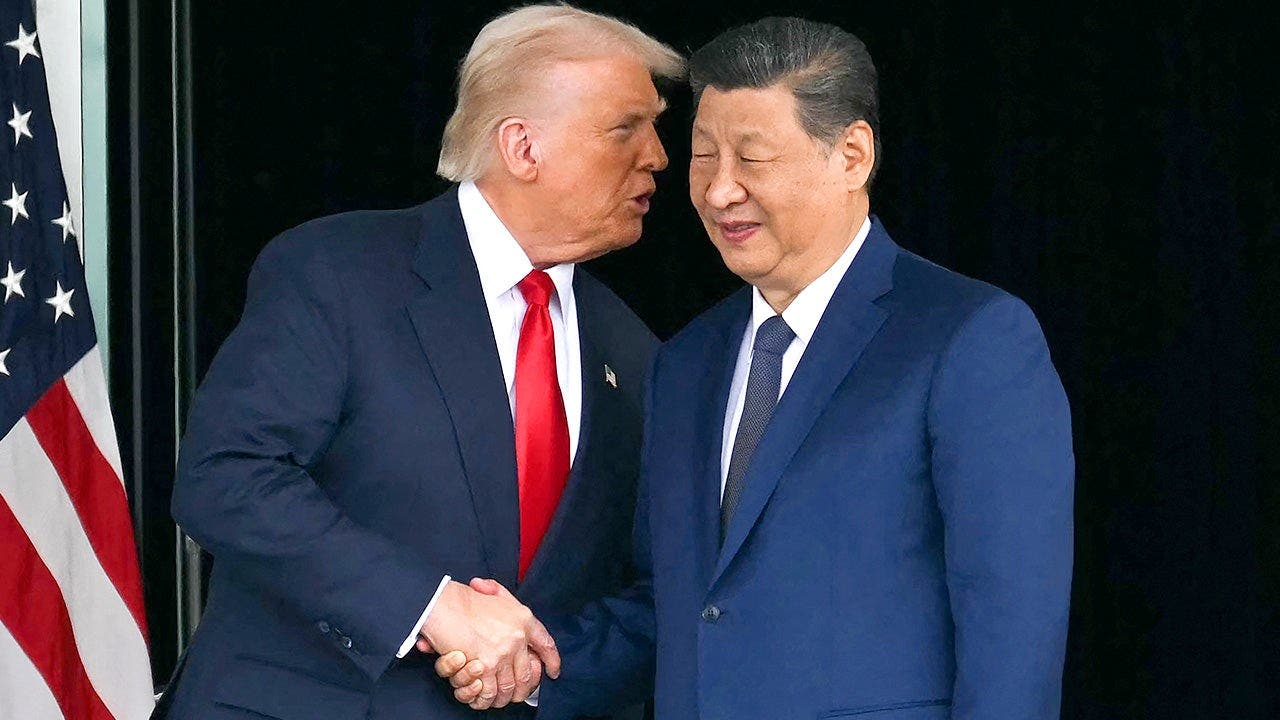
President Donald Trump arrived in Beijing for talks with China's President Xi Jinping, bolstered by his military and trade actions over the past 16 months.
Media outlets portrayed Trump as weakened by the Iran war while depicting Xi as confident and ready to lead globally. The Washington Post wrote on Monday, May 11, "Xi is confident in his country’s power; Trump is weakened with U.S. mired in war." The Council on Foreign Relations stated Sunday that China holds the upper hand at the summit. The Post added, "Xi wants to project China as a more reliable and responsible counterweight to U.S. volatility."
Trump strengthened America's position against China. Last spring, China restricted export licenses for critical minerals, disrupting global factory production. Now the U.S. Navy controls China's main oil route through the Strait of Hormuz.
Xi spent the past year purging military officers, facing a slowing economy, and addressing China's lag in artificial intelligence by focusing inward.
Trump secured trade deals worldwide that drew trillions in foreign investment. He defeated Iran's military and ousted Nicolas Maduro in Venezuela, a Chinese ally. The U.S. Pacific Fleet intercepted shadow tankers supplying oil from Iran and Russia to China's teapot refineries. Operation Epic Fury showcased U.S. military power and impressed China's People's Liberation Army.
Some China experts say Trump loses prestige by meeting in Beijing. Trump brought CEOs including Elon Musk of Tesla and SpaceX, and Larry Culp of GE Aerospace.
Trump aims to negotiate directly with Xi.
Four key topics emerged for the Beijing talks.
On trade, U.S. Trade Representative Jamieson Greer testified April 28 that the goods deficit with China dropped to $202 billion in 2025, the lowest since 2004. China's share of total U.S. imports fell to about 9 percent, the lowest since it joined the World Trade Organization in 2001. Trump seeks a stable, balanced relationship through managed trade with sector-by-sector tariff talks and expanded trade in non-sensitive goods.
Export deals top the list, especially agriculture like soybeans, dairy, and corn. Farmers want a long-term agreement despite China's past failures to honor similar promises. Boeing could sell up to 500 airliners to China; CEO Kelly Ortberg joins the trip. These steps aim to narrow the trade deficit.
On Iran, Trump plans to press China over sales of sodium perchlorate and other chemicals for ballistic missile fuels. Secretary of State Marco Rubio recently imposed sanctions on Chinese satellite imagery companies and Qingdao Haiye Oil Terminal Co., which handles Iranian oil. Reduced oil supplies could harm China's plastics and chemicals sectors.
On artificial intelligence, the U.S. government's National Institute of Standards reported May 1, 2026, that OpenAI GPT 5.5 leads China's DeepSeek V4 Pro by about eight months. U.S. tech firms compete through innovation and global deployment.
China remains a strong military rival. It reclaims land for bases in the South China Sea and doubled its nuclear missiles from about 250 to over 600, with expansion ongoing. Trump's trade and military approach demonstrates U.S. global leadership.
What's Your Reaction?
 Like
0
Like
0
 Dislike
0
Dislike
0
 Love
0
Love
0
 Funny
0
Funny
0
 Wow
0
Wow
0
 Sad
0
Sad
0
 Angry
0
Angry
0




Comments (0)