

Satellite Images Show Suspected Oil Slick Spreading Near Iran's Kharg Island Export Terminal

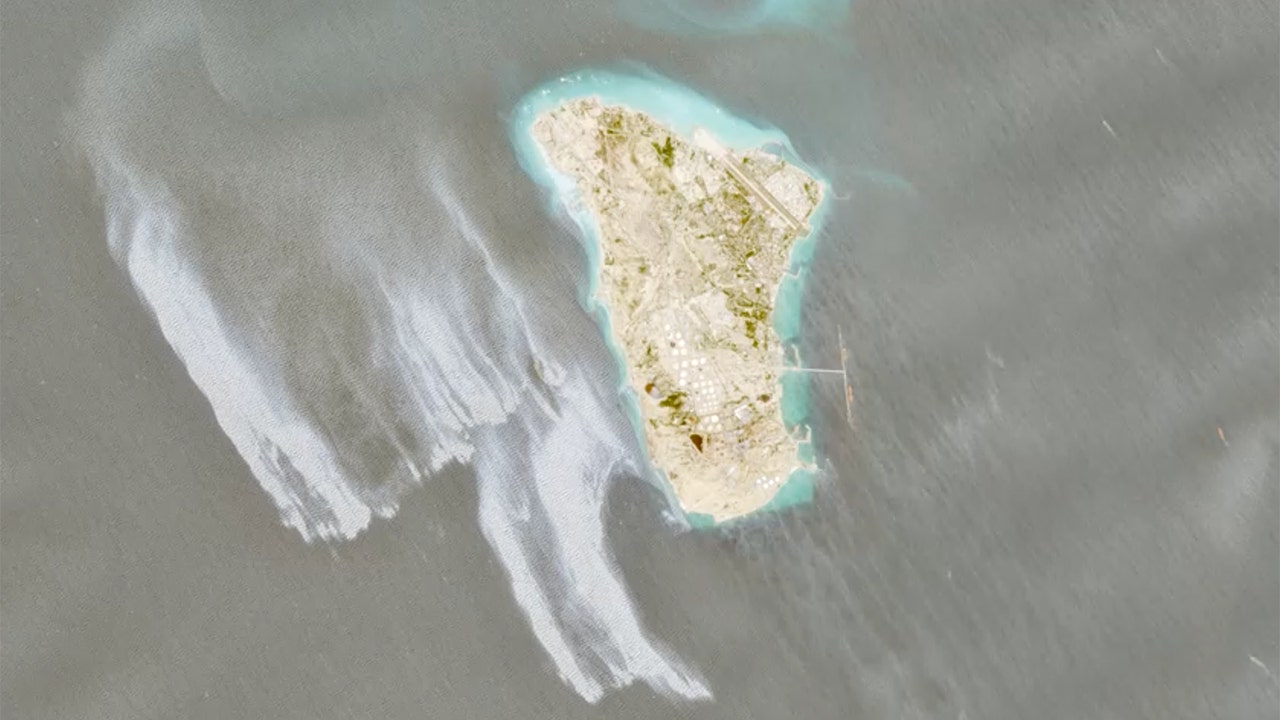
Satellite imagery has revealed a large suspected oil slick near Kharg Island, Iran's primary oil export terminal. Analysts say it points to strain on Tehran's oil infrastructure from U.S. pressure.
Copernicus Sentinel satellite images from Wednesday to Friday showed the slick covering about 45 square kilometers west of the island, according to analysts cited by Reuters.
The slick appeared as a gray and white plume west of the 8-kilometer-long island. Leon Moreland, a researcher at the Conflict and Environment Observatory, told Reuters it looked visually consistent with oil. Louis Goddard, co-founder of consultancy Data Desk, said it could be the largest spill since the U.S.-Israel war against Iran began about 70 days ago.
Miad Maleki, an Iran sanctions and energy expert at the Foundation for Defense of Democracies, offered two possible explanations to Fox News Digital. "One is operational: they simply didn’t ramp down extraction fast enough relative to their true onshore capacity and over-counted on empty tankers slipping through the blockade," he said.
"Now they’ve effectively over-delivered crude into the export system, with more oil at or near the terminals than they can actually load, and the ‘solution’ is to push some of that excess into the water."
Maleki pointed to another possibility: mechanical failure from Iran's use of aging tankers as floating storage or sanctions-busting carriers. "They’ve dragged older, marginal tonnage into service as floating storage or sanctions-busting carriers, and some of those retired or poorly maintained hulls are now leaking," he said.
"Either way, the common denominator is the same — storage and evacuation capacity are out of sync with upstream output, and the Gulf is paying the price for that mismatch."
The incident ties into the Trump administration's pressure campaign, which pairs sanctions with a U.S. naval presence near the Strait of Hormuz to curb Iran's oil exports. Before the conflict, Iran shipped about 1.5 million barrels per day, much of it to China.
Kharg Island processes 90 percent of Iran's oil exports and serves as a key bottleneck in efforts to cut the regime's revenue during the war. Analysts note the blockade and sanctions threats have complicated Tehran's ability to ship crude from the island.
Energy analysts say Iran faces a bind. Without export routes or extra storage, Tehran might shut wells and risk field damage, or dump excess crude and cause Gulf-wide environmental harm.
"They’ve already reduced extraction. In a true blockade scenario, the constraint isn’t production at the wellhead, it’s the inability to load tankers at export terminals," Maleki said. "Once onshore storage nears capacity, output has to be cut to match remaining headroom or wells get shut in. In Iran’s case, that’s roughly 13 days."
Windward, a maritime risk intelligence firm, estimated the slick moved southeast at 2 kilometers per hour. It warned the spill could enter Qatar’s exclusive economic zone in days and reach the United Arab Emirates in two weeks.
The Gulf's desalination plants, vital for millions, stand especially at risk from oil contamination. The spill occurs amid war-related tensions that have trapped hundreds of vessels and disrupted global crude and liquefied natural gas supplies.
Iranian authorities have not commented publicly on the slick or its causes. Fox News Digital contacted the Iran mission to the United Nations for response.
What's Your Reaction?
 Like
0
Like
0
 Dislike
0
Dislike
0
 Love
0
Love
0
 Funny
0
Funny
0
 Wow
0
Wow
0
 Sad
0
Sad
0
 Angry
0
Angry
0





Comments (0)