

Russia Test-Fires Sarmat ICBM as Putin Claims Ukraine Conflict Nears End

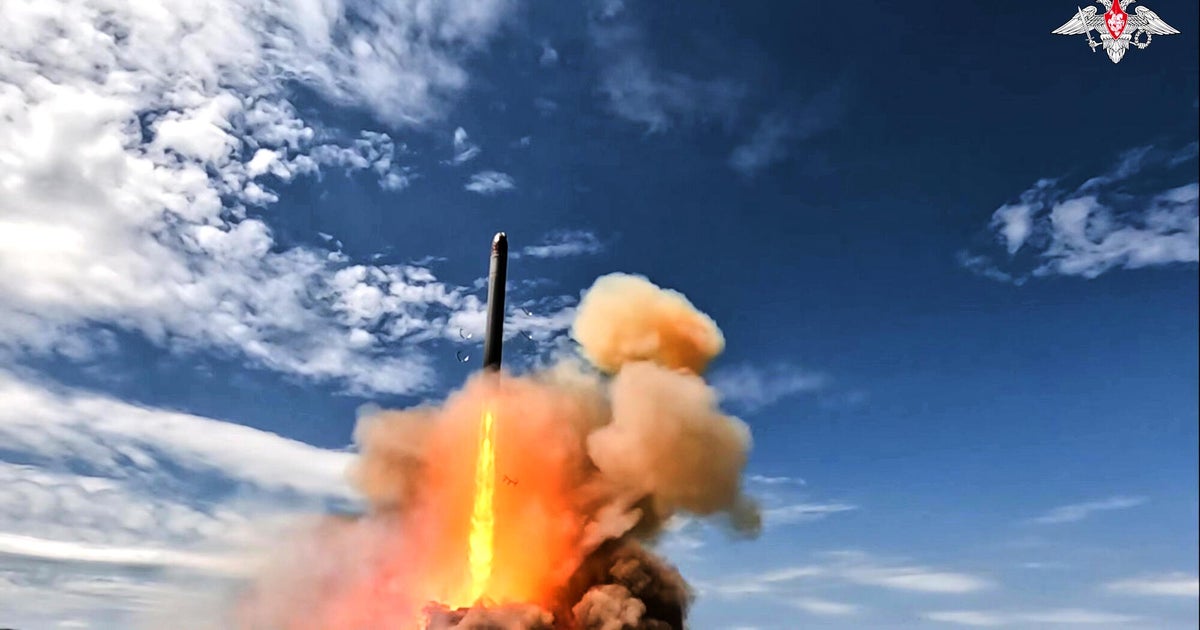
Russia test-fired a new intercontinental ballistic missile on Tuesday as part of efforts to modernize its nuclear forces. President Vladimir Putin praised the launch just days after stating that the fighting in Ukraine is nearing an end.
Putin said the nuclear-armed Sarmat missile will enter combat service at the end of the year. It is designed to replace the aging Soviet-built Voyevoda.
"This is the most powerful missile in the world," Putin said. He claimed the combined power of the Sarmat's individually targeted warheads exceeds that of any Western counterpart by more than four times.
The Russian leader has repeatedly highlighted his nuclear arsenal since sending troops into Ukraine in February 2022. He aimed to deter the West from increasing support for Ukraine.
Putin oversaw a military parade on Red Square on Saturday to mark the defeat of Nazi Germany in World War II. The event, the first in nearly two decades without heavy weapons, came as he declared the Ukraine conflict is coming to an end.
Since taking power in 2000, Putin has directed upgrades to the Soviet-era components of Russia's nuclear triad. Those efforts include deploying hundreds of new land-based intercontinental ballistic missiles, commissioning new nuclear submarines and modernizing nuclear-capable bombers.
Russia's nuclear modernization has prompted the United States to pursue a costly upgrade of its own arsenal.
The last remaining nuclear arms pact between Russia and the United States expired in February. That left no limits on the world's two largest atomic arsenals for the first time in more than half a century and raised fears of an unconstrained arms race.
In the same month, the United States and Russia agreed to restore formal high-level military communications. Those channels had been suspended in late 2021 before Russia's full-scale invasion of Ukraine.
The Sarmat, which NATO calls "Satan II," is intended to replace about 40 Soviet-built Voyevoda missiles. Development started in 2011. Before Tuesday, it had one known successful test and reportedly suffered a massive explosion during a failed test in 2024. A satellite image analyzed by CBS News showed a large crater and explosion remnants on a launchpad at Plesetsk Cosmodrome in northern Russia.
The Center for Strategic and International Studies' Missile Defense Project classifies the Sarmat as a "heavy" ICBM capable of carrying up to 10 tons in payload.
Putin said Tuesday that the Sarmat, one of several new weapons he unveiled in 2018 and claimed would defeat U.S. missile defenses, matches the Voyevoda's power but offers greater precision. It can fly suborbitally with a range over 21,700 miles, he added, and has enhanced ability to evade missile defenses.
Moscow's new systems include the Avangard hypersonic glide vehicle, which travels 27 times the speed of sound. The first units have entered service.
Russia has commissioned the nuclear-capable Oreshnik intermediate-range ballistic missile and used its conventional version twice against Ukraine. With a range up to 3,100 miles, Oreshnik can hit any target in Europe.
Putin announced that Russia is in the final stages of developing the nuclear-armed Poseidon underwater drone and the Burevestnik cruise missile powered by miniature atomic reactors. The Poseidon would detonate near enemy coastlines to generate a radioactive tsunami. The Burevestnik offers virtually unlimited range through nuclear propulsion, allowing it to circle air defenses for days before striking.
Putin has presented those weapons as Russia's answer to the U.S. missile defense system. Washington developed it after withdrawing from a Cold War-era U.S.-Soviet pact on missile defenses in 2001.
Russian military planners worry such a shield might encourage Washington to attempt a first strike. That could destroy most of Moscow's nuclear forces, leaving only a few retaliatory missiles for interception.
"We were forced to consider ensuring our strategic security in the face of the new reality and the need to maintain a strategic balance of power and parity," Putin said.
The treaty that expired in February was a bilateral U.S.-Russia agreement. The two countries hold about 4,300 and 3,700 nuclear warheads respectively, according to the Federation of American Scientists.
What's Your Reaction?
 Like
0
Like
0
 Dislike
0
Dislike
0
 Love
0
Love
0
 Funny
0
Funny
0
 Wow
0
Wow
0
 Sad
0
Sad
0
 Angry
0
Angry
0



Comments (0)