

Monkey owner fears pets could be put down under new licence rules

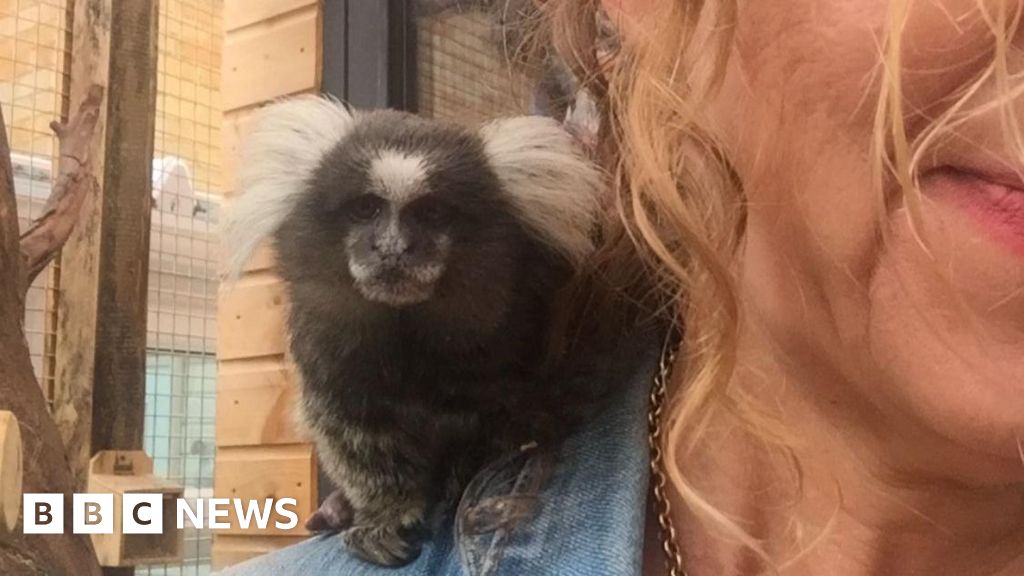
Lisa-Marie Bearman shares her three-bed terrace home in Kent with a dozen marmosets. The troop is her entire life, she says, and their enclosure dominates her garden.
She has given up holidays with her husband for 16 years to care for them. Now she fears they could be taken away and put down after a change in the law.
The government has introduced a licensing scheme that requires the thousands of pet monkeys in the country to be kept in zoo-like conditions. The Department for Environment, Food and Rural Affairs said primates needed zoo-level welfare standards and it was working with local authorities on enforcement.
Only a small number of licences have been granted, with none issued in Kent, the BBC has found. Animal welfare experts warn thousands of monkeys could be put down in a potential mass euthanasia of primates.
Bearman's garden in Rochester is never quiet. The marmosets share the space with a rabbit, two tortoises and a dog. The animals are among the 3,000 to 5,000 primates the government estimates are kept privately across the UK.
Bearman, a clinical hypnotherapist, said she has loved monkeys since she was a child. "In the real, most beautiful world, all animals would be free, but their natural habitat has been destroyed and these monkeys have been born in captivity," she said. "Their care comes from us as a family giving them everything we possibly can."
The Animal Welfare (Primate Licences) (England) Regulations 2024 came into force on 6 April 2026. Owners found to have primates without a licence face a six-month prison sentence and an unlimited fine.
To acquire a licence, keepers must meet zoo-like welfare conditions. These include both outdoor and indoor space, a diet tailored to each primate's needs, and housing that allows normal behaviour. For a pair of marmosets the outdoor enclosure must be at least 2.5m by 4m by 2.5m.
Bearman believes licences are needed but was surprised by how strict the requirements were. "The licence really isn't designed around private keepers living in their homes and gardens, where we're very limited by height, size restrictions and planning permissions," she said.
Many welfare organisations, including the RSPCA, do not believe home environments can ever be suitable for a primate and continue to call for a full ban. When the policy was announced in 2024, a government minister said it was essentially incorrect to claim the licence was not a ban.
Bearman has applied for a licence and says she meets 90% of the requirements. She is concerned she will be unable to meet the height and size rules because of planning permission limits. She is still waiting for an inspection from her local council.
She has had to desensitise from the worrying part for the sake of her and her husband's health, she said. While she is unsure what the outcome will be, she is certain of one thing. "I will do anything to keep my monkeys," she said.
There are also concerns about what will happen to monkeys that remain unregistered. Connor Gordon, head keeper of the Fenn Bell Conservation Project in Rochester, supports the law but has concerns about it. He says the industry is preparing for a potential influx of animals whose owners are unable to obtain licences.
Changes made by Defra have made it easier in recent weeks for primate owners, he says, but it is still not going to be easy for anyone to keep a primate in their home. "There are significant costs in producing enclosures," he said. "During that time, you are technically housing that animal illegally."
He says there are a million and one things that would make it difficult for zoos like Fenn Bell to take in primates from owners who cannot obtain a licence. "There are only a finite number of homes these primates can go to. I don't have infinite space, and I'm sure the story is the same for every other zoo out there. There is the risk we are potentially looking at a mass euthanasia of animals that can no longer be housed appropriately."
A Freedom of Information request sent by the BBC to 294 councils suggests that, as of 24 February, only one licence had been granted, just over a month before the regulations came into effect. This licence covered only eight primates. Former glamour model Jodie Marsh has since been granted a licence, as has a college in Grimsby. A further 13 licences were pending, covering another 63 primates.
All but one of the internationally recognised sanctuaries in the UK which the BBC spoke to said they would struggle to take in primates. Lindsey McKenna, founder of Wildlife Exotic Rescue, said she had already had to turn away primates. Based in Herefordshire, she has previously taken in monkeys from across the country and now has a waiting list.
Like Gordon, McKenna supports the licence system in the long term but worries that in the short term there will be a sacrificial generation of primates. "I think it's going to be very, very hard for a primate owner to go from a hamster cage in their bedroom to over 15 to 19 square metres of indoor and outdoor enclosure," she said. "They've suffered enough. And now we're going to let them suffer more."
A Defra spokesperson said the new laws meant that primates, highly intelligent and complex animals, must be provided with zoo-level welfare standards where they are kept by private keepers. "We urge private keepers to make sure they are licensed and complying with these high welfare standards, and we are working with local authorities on how to enforce the new licensing scheme," they added.
What's Your Reaction?
 Like
0
Like
0
 Dislike
0
Dislike
0
 Love
0
Love
0
 Funny
0
Funny
0
 Wow
0
Wow
0
 Sad
0
Sad
0
 Angry
0
Angry
0







Comments (0)