

Homeland Security Secretary Mullin Says ICE Won't Round Up Migrants at World Cup

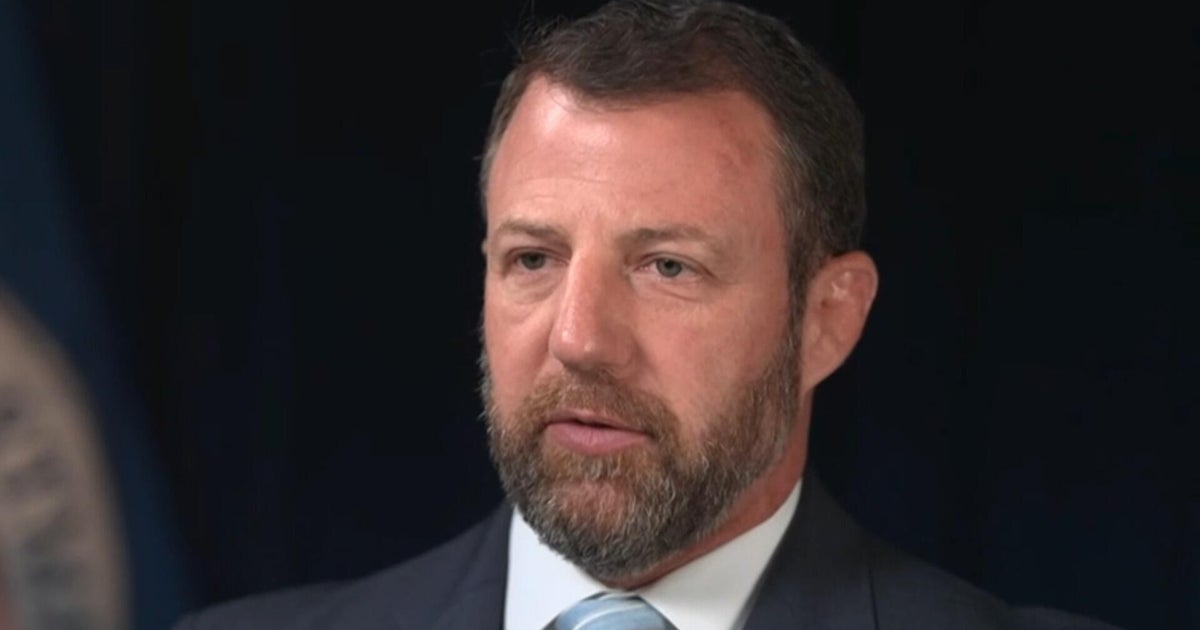
Homeland Security Secretary Markwayne Mullin told CBS News that Immigration and Customs Enforcement arrests at this summer's FIFA World Cup in the U.S. remain possible, but the agency will not attend the event to round up non-citizens.
Mullin gave the exclusive interview on Tuesday, nearly two months after taking over the Department of Homeland Security. The agency has faced months of turmoil, including its longest shutdown ever, the exit of former Secretary Kristi Noem and backlash over the Trump administration's immigration policies after two U.S. citizens died in Minneapolis. Now DHS faces a demanding stretch with the World Cup, hurricane season and a hantavirus outbreak on a cruise ship.
DHS and ICE expect to handle major security duties at the World Cup, which will draw dozens of international soccer teams and more than a million foreign tourists to 11 U.S. cities.
When asked if he could guarantee that ICE's role at the tournament would stick to security instead of targeting undocumented migrants, Mullin stressed the agency's duty to enforce customs laws.
"It's Immigration and Customs Enforcement," he said. "So what do you find at a tremendous amount of sporting events? Counterfeit products, counterfeit tickets. You have counterfeit clothing being sold on the streets."
Mullin pointed out that ICE has appeared at big events like the Super Bowl for years. He said the agency draws criticism now because "media and the public" — he then specified "the Democrats" — have painted it as a villain.
Law enforcement sometimes spots criminal suspects at these events, Mullin added, including people wanted for murder, drug trafficking or other felonies, plus those flagged by Interpol, the International Criminal Police Organization.
"When they're at these sporting events, we're not out there doing immigration enforcement," he said. "But we are looking for, maybe we have people that shouldn't be in this country because they're on terrorist watchlists."
Pressed further on whether the World Cup mission excludes immigration enforcement, Mullin allowed for some ICE arrests.
"Well, ICE always says immigration enforcement. We're always going to do that. But we're not there for solely that purpose. We're in there to do our job," he said. "We're not there to go round up mass individuals, but we are always looking for the worst of the worst. We're going to continue to do that."
ICE faces a leadership change at month's end. Acting Director Todd Lyons is leaving government, with David Venturella stepping in as interim head. Venturella, a veteran immigration official who once worked at the for-profit prison firm GEO Group, will lead while DHS hunts for a permanent director. The agency has lacked a Senate-confirmed leader for years.
"We want to put somebody there that's permanent," Mullin said. "David is going to be a good placeholder, but he'll be our deputy once we find someone to take the director's position."
On the recent DHS shutdown, Mullin said, "We quit having the ability to be proactive."
Most of DHS ended the longest U.S. government shutdown on record two weeks ago. Funding lapsed in mid-February amid congressional fights over Democratic demands to reform immigration agencies, intensified after two U.S. citizens were shot dead by immigration agents in Minnesota.
Congress approved funds last month for all DHS components except ICE and Border Patrol through September. Republicans plan to fund those two separately through fiscal year 2029 without Democratic support.
The 76-day shutdown pushed DHS to its limits. Hundreds of Transportation Security Administration officers quit over unpaid checks, staff went on furlough, Coast Guard sites lost power and water from unpaid bills, and DHS offices ran short on basics like paper clips.
Mullin said another shutdown would let DHS keep delivering services but erode morale and raise security risks for Americans.
"The American people saw [DHS] is still going to deliver on mission, but it's going to continue to hurt our morale and put the American people at risk," he said.
Late in the shutdown, DHS lost its edge, Mullin added. "At some point you have to quit being proactive. Towards the end of the shutdown, we quit having the ability to be proactive … Not as proactive as we wanted to. We just have to choose missions."
He noted that U.S. adversaries kept operating and knew DHS was weakened. Workforce cuts worsened matters: the Cybersecurity and Infrastructure Security Agency lost 1,100 staff in the past year, while TSA shed 8.6 percent of its employees. TSA handles security for pipelines, infrastructure and venues like the World Cup's 11 sites.
On shutdown risks, Mullin said, "These have huge national security implications. We have 22 components, all of them deal with national security."
DHS gets daily hantavirus briefings as health officials tackle a deadly outbreak tied to a Dutch-flagged cruise ship. The department coordinates with Health and Human Services Secretary Robert F. Kennedy Jr. and the White House.
"This is not COVID," Mullin said. "This is not COVID at all." He urged Americans not to panic while treating the matter seriously.
FEMA will respond to hurricanes starting June 1, Mullin said, though states must step up more. The Trump administration has considered cutting or eliminating FEMA; a presidential council this month called for a slimmer agency that pushes responsibility to states.
Most governors grasp that disaster response is shared, Mullin said.
"They understand that the state has responsibility and the federal government isn't there to take care of all their problems," he said. "The states have a role, and we have a role."
DHS talks daily with governors. "With the exception of one governor, it's just been a great conversation."
Mullin would not name that governor but added, "At some point, if I've got to expose this governor, I will be happy to expose this governor. But right now, I'm going to give this gentleman the benefit of the doubt, and we're going to work through it."
FEMA aid keeps flowing, he said, though it was never meant to cover full recovery. To those fearing no federal help in hurricane areas, he replied, "We're still going to show up. Absolutely we're going to show up."
Mullin praised Florida Gov. Ron DeSantis and Florida Division of Emergency Management Executive Director Kevin Guthrie as models.
"Florida could be a model on how to handle disasters," he said. "And if Florida can do it, then other states can do it too."
The federal government cannot fix every local disaster need, Mullin concluded.
"If you think the government is here to take care of all your problems, you're sadly mistaken," he said. "We're there to help you get started again on your very, very worst day."
What's Your Reaction?
 Like
0
Like
0
 Dislike
0
Dislike
0
 Love
0
Love
0
 Funny
0
Funny
0
 Wow
0
Wow
0
 Sad
0
Sad
0
 Angry
0
Angry
0





Comments (0)