

Holocaust survivor Sonja Ibermann Cowan, 102, shares her story with Berlin neighbor

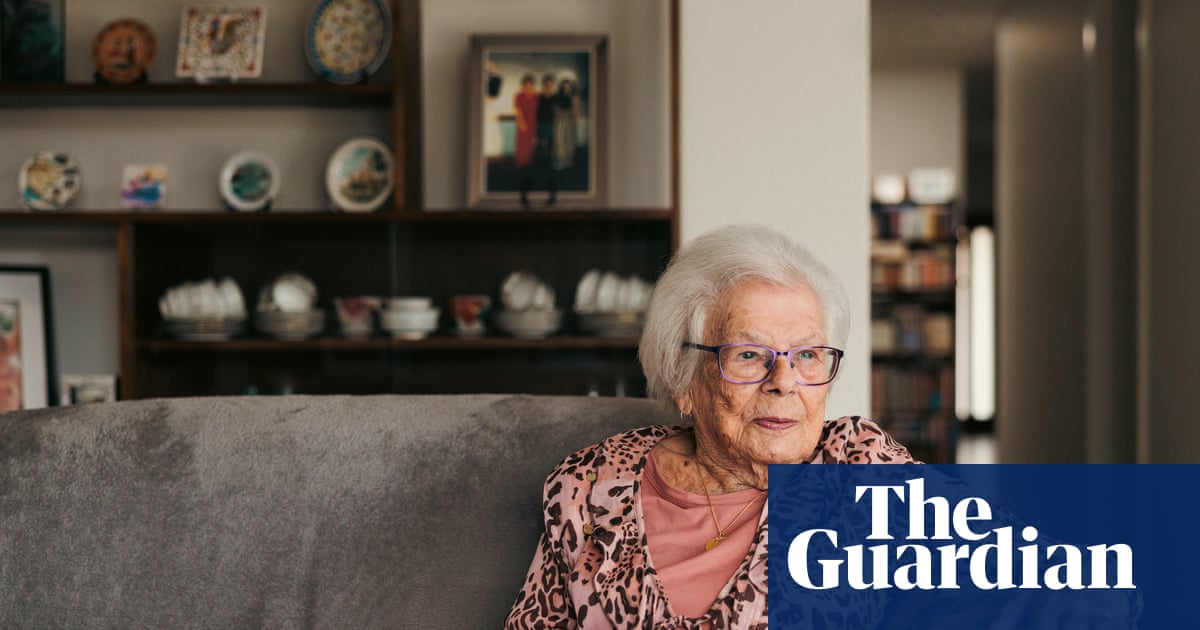
At the age of 102, Sonja Ibermann Cowan has little interest in wasting time. She sings to her great-grandchildren, shares meals with her three daughters and marks the high holidays with her rabbi in Melbourne, who makes house calls.
Five years ago she began a friendship with a neighbor in Berlin, the city of her birth. The pandemic gave her family time to look back. Her grandson Benjamin Preiss, a journalist at The Age newspaper in Australia, began researching her life and the murders of her mother and sister in the Holocaust.
In July 2020, Preiss contacted the Berlin neighbor after reading an essay that mentioned his great-aunt Lotte and great-grandmother Taube. He said his grandmother Sonja was still alive and wanted to talk.
The essay, written after Donald Trump’s first inauguration, described memorials to Nazi victims in the German capital. It focused on the Stolpersteine, small brass plaques set in the pavement in front of the last homes of Holocaust victims. Two of the plaques lie outside the neighbor’s building and are dedicated to Sonja’s mother Taube Ibermann, known as Toni, and Toni’s eldest daughter Lotte.
The first conversation took place in September 2020 on a lockdown video call. Sonja appeared with a bright smile and rose-colored lipstick. She was 97, self-possessed and quick with a joke. She spoke with a German-Scottish accent that carried a trace of Australian.
Sonja was born in Berlin in 1923, one of three daughters of observant Jews from Poland. Her father died of a heart attack at 29, leaving her mother Toni to support the family as a seamstress. Sonja said she did not have an easy childhood.
Adolf Hitler came to power when Sonja was nine. Within a few years she was expelled from public school along with other Jewish children. She continued her studies at a Jewish school in the grounds of the Rykestraße synagogue.
After Kristallnacht in November 1938, Toni sent Sonja to an agricultural training camp in rural Steckelsdorf. In August 1939, at age 16, Sonja left Germany on the 28th Kindertransport to Britain. It was the last time she saw her mother.
Her sister Lotte had aged out of the Kindertransport and stayed behind with Toni. Records show the two were deported together to the Łódź ghetto on 27 October 1941. Sonja learned decades later that both were killed there.
Sonja reached north Wales speaking no English. She later joined the British army, where she learned the language while working in military storerooms. After the war she married Ralph Cohen, a fellow veteran. The couple had three daughters and later moved to Melbourne.
Sonja has returned to Berlin twice. She said the first visit, at age 70, did not feel right. The second, just before she turned 90, allowed her to visit places she remembered, including her father’s grave.
Her grandson Benjamin is now writing about her experiences for a master’s degree. He has examined deportation lists, family letters and Nazi records. He found that Toni and Lotte were forced to work for Siemens in Berlin before their deportation.
Tenth-grade students at a local Berlin school recently interviewed Sonja about her life under the Nazis. Using her recorded answers, the students produced a podcast in German, French and English.
The neighbor continues to polish the Stolpersteine outside the building and sends photographs to Sonja. The family thanks the neighbor for “taking care of our girls.”
What's Your Reaction?
 Like
0
Like
0
 Dislike
0
Dislike
0
 Love
0
Love
0
 Funny
0
Funny
0
 Wow
0
Wow
0
 Sad
0
Sad
0
 Angry
0
Angry
0




Comments (0)