

Gates: U.S. and China not yet equal powers despite nuclear and industrial risks

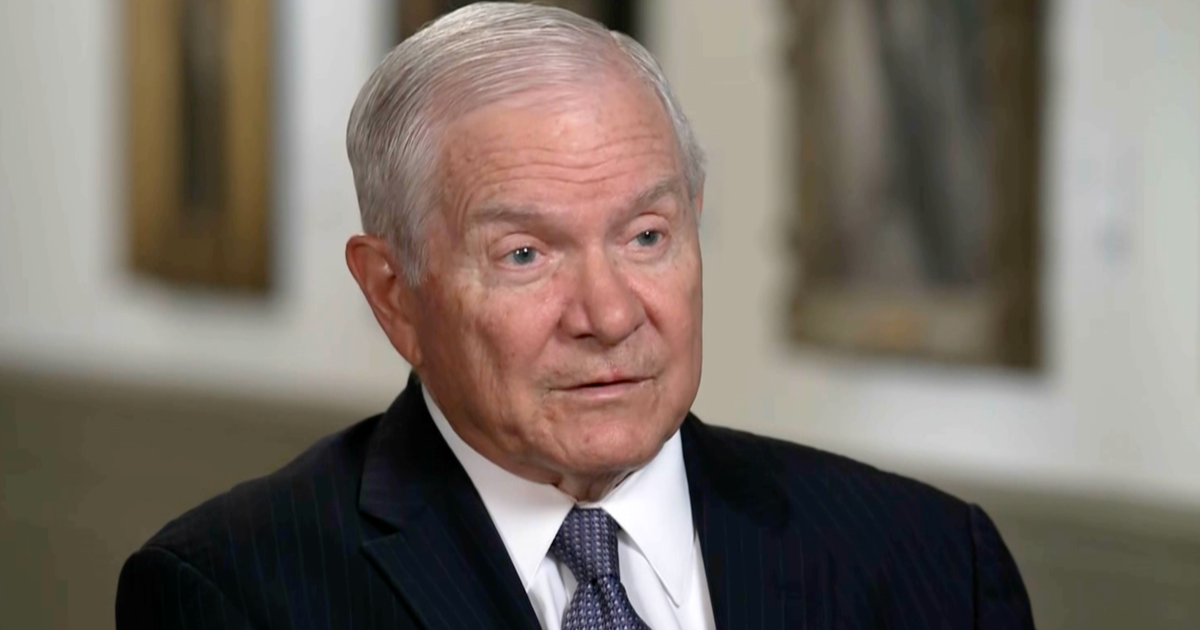
Former Defense Secretary Robert Gates said the United States still holds an edge over China in military, economic and technological power, but he warned that the combination of nuclear-armed adversaries in Europe and Asia makes this one of the most dangerous periods in modern American history.
Speaking on Face the Nation, Gates said that once China completes its strategic nuclear modernization, Beijing and Moscow together will have nearly twice as many deployed strategic nuclear warheads as the United States. He added that China has greater manufacturing and industrial capacity than any country the United States has faced since the British Empire, and that Beijing wields more non-military tools of power than the Soviet Union ever did.
Gates said he does not yet view the United States and China as equals. He described China as a near-peer competitor whose military is catching up, though the United States retains leads in the economy and technology. He noted that both countries face domestic challenges, including economic and demographic pressures in China.
On the recent Trump-Xi meeting, Gates said the main goal for both sides appeared to be keeping the relationship stable and preserving the trade truce that has lasted about a year. He said the summit produced few concrete deliverables beyond working groups on artificial intelligence and tariffs.
Gates said the United States should maintain its long-standing position of strategic ambiguity on Taiwan. He said any shift in wording would be a mistake and that President Trump had kept the carefully calibrated stance intact. He urged the administration to approve the pending $14 billion in arms sales to Taiwan, while noting the existing backlog of undelivered weapons and the need to focus on systems that could help repel an amphibious invasion.
Gates called the depletion of U.S. weapons stockpiles a serious problem. He said the administration and Congress must accelerate efforts to expand defense production, including by bringing new companies into the industrial base. He said the United States needs to act with the urgency of a wartime economy to replenish precision-guided munitions, Patriot and THAAD missiles, and other key systems.
On the risk of a Chinese invasion of Taiwan, Gates said the chances remain low in the near term. He said Beijing has other options, including a blockade or quarantine that could strangle the island over time, and that Chinese leaders would prefer a slower political transition. He also questioned the readiness of China's military, noting that Xi Jinping has removed many senior officers and that no current Chinese general or admiral has combat experience.
Gates said the only realistic way to remove Iran's enriched uranium and end its nuclear program is through negotiation. He said military strikes can damage facilities but cannot solve the underlying problem. He added that the United States cannot walk away from the issue and leave it to Israel.
Gates said he does not expect a near-term popular uprising in Iran. He said the regime's internal controls remain strong and that any change is more likely to come from fractures within the leadership than from street protests.
On Pentagon leadership, Gates praised efforts by the deputy secretary and undersecretary for acquisition to expand industrial capacity and bring new companies into defense work. He said he is concerned about the large number of recent firings of senior military officials and believes the rationale for those changes should be explained to Congress and the public.
Gates rejected the characterization of William & Mary as a "woke breeding ground of toxic indoctrination." He said the campus maintains strong ties to the military, including an active ROTC program, and that the military will continue to engage with universities through those channels.
What's Your Reaction?
 Like
0
Like
0
 Dislike
0
Dislike
0
 Love
0
Love
0
 Funny
0
Funny
0
 Wow
0
Wow
0
 Sad
0
Sad
0
 Angry
0
Angry
0




Comments (0)