

Evacuations ordered near Garden Grove aerospace plant over leaking chemical tank

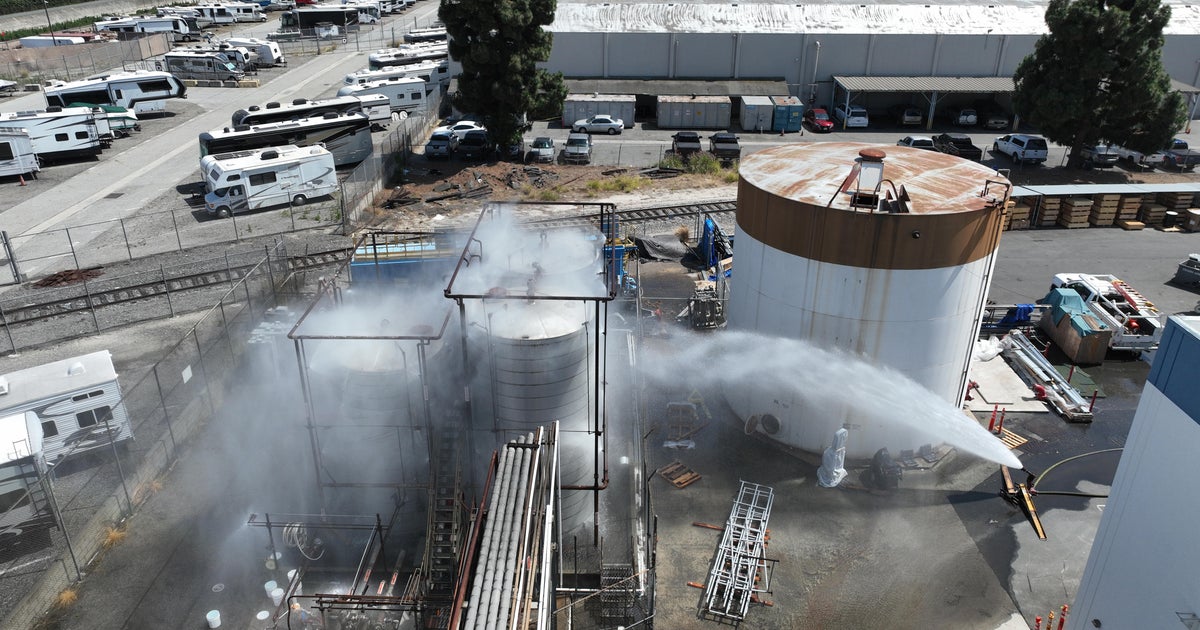
Tens of thousands of Southern California residents have been evacuated after officials warned that a leaking chemical tank at an aerospace facility could fail and explode.
The tank at GKN Aerospace holds an estimated 7,000 gallons of methyl methacrylate, a highly volatile substance used in plastics production, Orange County Fire Authority Chief Craig Covey said. It is not clear when the tank will fail.
California Gov. Gavin Newsom declared a state of emergency for Orange County on Saturday. He said the state is mobilizing every available resource to support local responders and ensure residents have what they need to stay safe.
Methyl methacrylate generates heat on its own. If it leaks, any spark could trigger an uncontrolled fire or explosion, said Elias Picazo, an associate professor of chemistry at the University of Southern California. Fire crews are working to keep the tank cooled.
Officials had believed temperatures inside the Garden Grove tank were dropping. After crews entered the danger zone, they found temperatures rising about 1 degree per hour. The tank reached 90 degrees Friday night after starting the day at 77 degrees, Covey said in a video posted to X on Saturday.
Covey told CBS Los Angeles this is the most dangerous event he has handled in decades of fire service.
"This is bad as I've ever seen," he said.
No injuries or deaths have been reported. GKN Aerospace is in Garden Grove, about 38 miles south of Los Angeles.
Methyl methacrylate is a respiratory irritant. Exposure can cause lung, skin and eye irritation, nausea and dizziness, health experts told CBS Los Angeles.
Covey said two outcomes are possible. The tank could fail and spill thousands of gallons of chemicals into the parking lot and surrounding area. Because the chemical is heavier than air, its vapor would settle. Crews have built sandbag barriers to keep any spill out of storm drains and waterways.
The tank could also explode, sending methyl methacrylate particles into the air. It is unclear how far or how dangerous such an explosion would be. An uncontrolled blast could also affect nearby tanks holding other chemicals and fuel.
Efforts to cool the tank continued Saturday. Covey and other officials are also looking for other ways to end the incident safely.
"Letting this thing just fail and blow up is unacceptable to us," Covey said. "Our goal is to find something and not allow that to happen."
No particles that could harm public health have entered the air as of Friday, and no active plume is coming from the tank, Covey said. Residents have been advised to stay indoors.
Homes within a one-mile radius of the facility have been evacuated. There is no timeline for lifting the orders.
The cause of the leak remains under investigation.
What's Your Reaction?
 Like
0
Like
0
 Dislike
0
Dislike
0
 Love
0
Love
0
 Funny
0
Funny
0
 Wow
0
Wow
0
 Sad
0
Sad
0
 Angry
0
Angry
0







Comments (0)